

Hello…!
Welcome to my Real and Wise (RAW) BLOG!!
These musings were initially posted on MEDIUM https://medium.com/@realandwise but I’m no longer supporting that platform with my energy.
I hope you’ll enjoy my authentic ‘RAW’ content.
I’ll be sharing literary offerings about various experiences throughout my journey on the planet as a melanated human being who happened to be born north of the 49th parallel.
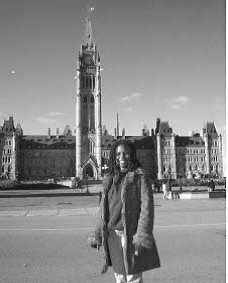
I decided to launch my blog during February (2022), traditionally known as Black History or African Heritage month in the United States and Canada, to honour those Ancestors who delivered countless messages of liberation to help heal humanity. (I still put the “u” in words for example neighbour. This is how us Canadians spelled words before American spell-check)
I’ll be lending insight into various social issues, my take on The Big Picture, life in general, mental health and anti-black racism through personal tales, anecdotes, etc.-
My observations as a mother, social-justice advocate and full-moon baby have allowed me to dig deep into the meat of the issues I address through my writings.
I’m happy the opportunity exists to have a space on this platform so I can share my ruminations with you, dear Readers.
In gratitude,
Roxanne a.k.a RAW
February 4, 2022
CROUTONS TO CAVIAR – February 4th, 2022
I was praying for a transformation. I seemed to be going ‘round and ‘round in circles from one administrative job to another when I decided to take a nine-month Digital Video Editing Program at Toronto Film School, a division of the International Academy of Design and Technology, in 2003 to hone my television production skills. I had become preoccupied with nurturing my artistic talents through the exposure I received being a research secretary in the scientific world of Medicine.
I recognized that to be a skilled creator of dramatic products, it is vital for me to understand the internal connections between all of the mediums I wanted to write for. In order to be a good artist, I had to be scientific, rigorous, methodical, analytical, and disciplined.
For years, I volunteered at Rogers Community Television in Toronto and garnered respect from my Producers, Editors, and Station Director because of my story-telling ability, professionalism, and personality.
“Time to move on to a bigger, more real station,” I thought.
I submitted ideas and proposals for shows and series one after the other, but only rejection letters came.
A few “we like your idea but … no thank-you” responses. Even a phone call from Denise Donlon, a former head of Much Music (currently known as Much in Canada) in the spirit of mentorship reminding me to label my demo (on VHS) tapes when sending them out.
An unmarked black tape can be disastrous in a room full of black tapes. Oops!
It felt like I was on the road to getting nowhere fast. And, my daughter Maia was growing like a well-fertilized flower.
I needed career stability for both of our futures. More importantly, I was searching for the answer to a question that had been brewing since my teenage years. “How do I fit into the Canadian landscape … where do I belong in this place I call home where strangers constantly ask where are you from?”
These concerns and questions presented an invitation for further self-reflection. This is why I decided to go to Goddard College.
Goddard’s alternative pedagogy offered the freedom and flexibility to assist my self-actualization and self-awareness process. I also believed Goddard’s specifically self-designed Master of Fine Arts in Interdisciplinary Arts Program would help me convert into the type of artist I knew I could be in a traditional and unorthodox capacity.
I set out on a journey to reclaim my birthright. To locate the “proof in the pudding” that demonstrated not only myself, but other black people had a legitimate stake in Canada.
An authentic dish cannot exist if there are missing ingredients.
I had to stir things up to claim my voice, to find the meat of my being. It was necessary to continue questioning personal and public politics because both contained recipes for the construction of my identity.
I didn’t want to believe Goddard’s motto “Come to Goddard as you are. Leave the way you want to be.” It seemed flaky and far-fetched.
But, it’s true. And, it’s real.
(excerpt from my MFA Portfolio Cooking Authentic Canadian Cuisine: Provisions For Your Soul. )
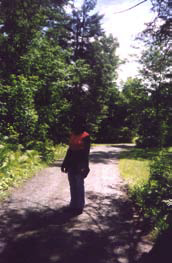
My face isn’t in the light which is symbolic ‘cuz I don’t know exactly where I’m heading…
I graduated from Goddard in 2007 with a Master of Fine Arts in Interdisciplinary Arts Degree.
To this day, it was one of the best decisions I’ve made.
It launched the beginning of a new path for me to really dig into self-discovery through meeting different people and having exciting adventures.
We can all only start at the very beginning, to understand who we are and where we’re going.
And, make sure to enjoy yourself along the way!
Do-Re-Mi— THE SOUND OF MUSIC (1965)
Cooking Authentic Canadian Cuisine – February 11th, 2022
“I have come to believe over and over again that what is most important to me must be spoken, made verbal and shared, even at the risk of having it bruised or misunderstood…”
Audre Lorde, from The Cancer Journals
I like people.
What I don’t like about them are the side effects of their unconscious acculturation. Environmental cues in our Western culture affecting everything we do from the type of coffee we drink to persuading women of African descent to chemically straighten their coiled hair.
I am an interdisciplinary artist because I enjoy creating something relevant that is both an extension of myself and that stems from various fields of knowledge and expertise. I re-interpret and fuse all my influences into artistic creations that stir and trigger varying degrees of latent emotions.
I remind people that we’re not merely occupying space on this planet to endlessly consume material goods. We are active, inter-connected participants in our own lives. If someone, someplace in the world is dying from contaminated drinking water, drought or famine, believe it or not, everyone in the world suffers. I can only hope when Bob Geldof launched
the Feed the World campaign, in the mid-eighties, this was the underlying message.
My genuine interest in humanity stems from having a multicultural ethnicity.
I am a first-generation Canadian of Guyanese, Amerindian (the Indigenous people of Guyana, South America), African, Scottish, and other yet-to-be-determined ancestries. When some people look at me, instead of seeing an interesting individual, they sometimes label me as just plain black.
Growing up in Canada, a landscape rich in diversity, has provided me with cultural nourishment. But, there have been bittersweet moments sprinkled throughout the course of my life. I have been affected by many people, including family members who have internalized “labels” imposed on them by society which has, in turn, stunted their spiritual, emotional, and intellectual growth. These labels place them in a state of constant fear that their current belief system might be incorrect or subject to change.
My art practice covers my preoccupation and passion for personal and political questions emanating from my childhood.
My goal is to expose audiences to work that allows them to see from the inside out.
All of my work is an attempt to break the silence imposed upon me at a young age.
By empowering myself, I simultaneously empower the voices of others as an artist, a mother, a black woman and a citizen.
I strive to create provocative works that challenge conventional perceptions of primarily black people. I manage to reveal, at times, rather disturbing facts by peeling away layers from traditional belief systems.
I question Canadian identity and what hidden ingredients make up authentic Canadian-ness. There is the Euro-centric image we are all fed, and the alternate reality that others, besides those of White Anglo-Saxon Protestant descent, have contributed valid stories to the Canadian narrative.
Some of the prominent themes in my creative and written works examine social constructs such as race, gender, class, and political issues.
I investigate the larger social, historical, and ideological systems that have shaped my identity and community by conducting research and exploring Canada’s Black history.
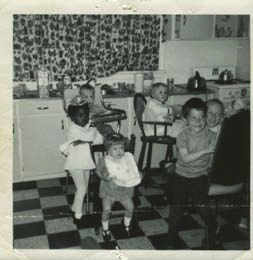
a.k.a “A Raisin in Milk”
“One cannot think well, love well, sleep well,
if one has not dined well.”
Virginia Woolf
February 11th, 2022 –
“Our deepest fear is not that we are inadequate. Our deepest fear is that we are powerful beyond measure. It is our light, not our darkness, that most frightens us. We ask ourselves, who am I to be brilliant, gorgeous, talented, and fabulous? Actually, who are you not to be? You are a child of God. Your playing small doesn’t serve the world. There’s nothing enlightened about shrinking so that other people won’t feel insecure around you. We are all meant to shine, as children do. We are born to make manifest the glory of God that is within us. It’s not just in some of us, it’s in everyone. And as we let our own light shine, we unconsciously give other people permission to do the same. As we are liberated from our own fear, our presence automatically liberates others.”
Marianne Williamson
While riding the streetcar en route to the grocery store on Friday November 10, 2006, I overheard a young woman explaining to her companion why she doesn’t visit her family.
She had caught her mother stealing her money. Hearing this struck a nerve because I experienced a similar crime. Not only did my own mother steal money from me, I was robbed of healthy foundational years every child deserves.
I was relinquished to my grandparents, Granny and Brother Jim (a.k.a. Bro-Jim), at seven months old.
Not only were they new immigrants to Canada, they were senior citizens receiving a fixed income living in rent-geared-to-income housing. Instead of experiencing abundance, I bore witness to scarcity by not being nourished emotionally and physically. In retrospect, Granny and Bro-Jim did their best given the circumstances.
My preoccupation with questions about the injustices of life began long ago during my childhood.
Examining the dynamics within my family, my first community, has been paramount, allowing me to reclaim what had been misplaced. This personal historical work is foundational to my practice of claiming voice.
“My mother spent my baby bonus money on Mark and Cecil. I didn’t even know what baby bonus was until grade seven when Angel Johnson told me what she was going to buy with hers. Granny said when she asked my
mother about it she said it wasn’t enough to buy groceries … but the groceries she was talking about weren’t even for me …”
from my memoirs
The following italicized excerpt from my memoir work, written from the voice of the child afraid to express herself, illustrates how in my early stages I knew and felt something wasn’t right.
Little Roxanne’s Voice:
Where is this mother person? I am aware something is wrong. Something doesn’t feel right. I know Granny is not my mother. I know Brother Jim isn’t my father. I am confused, sad, and getting impatient. I continue to wait.
I’m waiting. I’ve been waiting for years. My short little life has been spent waiting for her. I don’t remember her because I don’t see her much. I know her name is Mavis.
I hear Granny talking to her through the shiny black phone. My far-away mother person. I can hear she’s in Toronto with Cecil the man she married. I hear talk about a baby. A baby who isn’t me. Nobody seems to be talking to me or about me.
I am afraid to ask anyone questions because they won’t believe I can formulate these kinds of questions because I’m so little. But, I know. I know I am supposed to be with my mother. Where is she?
I wish I had my own bedroom with real furniture instead of being in this closet. I can’t believe this is my actual room. I’d like to have my own space for a change. Who am I going to complain to? My mother? I wish Mark and I could live together like a real brother and sister, but it looks like this isn’t going to be happening any time soon.
I’m stuck here on Caldwell with Granny and Brother Jim.
She never apologizes or says anything about me not living with them. They must all think I’m stupid and can’t put two and two together. I know they think I don’t understand what is going on. How come it seems alright for her to leave me here in Ottawa with practically nothing?
She is supposed to be my witness. Not Granny or Brother Jim. If she was dead it would be easier for me to understand her absence, but she’s alive living in Toronto with Cecil and Mark. Doesn’t she understand that Cecil doesn’t care about me?
I am brokenhearted. Whatever I do, wherever I go, a distress cloud follows me around like Pig Pen’s dust.
My personal history contributed to a fixation with critical social and cultural issues like abuse and oppression. Paulo Freire’s Pedagogy of the Oppressed articulates a wide range of emotions I felt prior to overcoming my own. Not only was I in the midst of a generation and culture gap, but I was also the only black child in my school consisting of about 100 students. And, the only born Canadian in my family.
My friend Vera Collymore started T.P. Maxwell Public School in grade five. Up until then, I was like a lonely raisin in a bowl of milk. In most places, events, or activities I ventured to I was always the only little brown face poking in the crowd. I must have known not to draw any unnecessary attention to myself for fear of further ostracism.
In Carol Talbot’s autobiographic work Growing up Black in Canada, she writes about her earliest experiences and memories at school in Southern Ontario. Talbot reflects on how her “poor little ego would shrivel into a tiny knot of insignificance even when the taunt was not directed at me …”.
In 1977, Vera’s presence at school was a new experience for me. We were immediately drawn to each other and became friends. At our recent reunion in 2002, twenty-something years later, Vera and I sat reminiscing about our school days.
Vera: Remember how badly Mrs. Clark allowed her kids Jennifer and David to treat us? They sure were spoiled children.
Me: I found out during high-school that Jennifer had MS and passed away.
That might be why she let them get away with murder.
Vera: I hated them.
Remember how she wouldn’t say anything when they called us Nigger … ?
Me: Yeah. I remember.
1977 was also the year Alex Haley’s mini-series “Roots” came out on television. Certain kids like Danny Whittle thought it would be fun to call us names like “Toby” and “Kizzie.” He was going at it one day when I decided we had enough. I broke on him and started ranting and raving about how we were human beings telling him to stop calling us those derogatory names. Whatever I said worked and he never harassed us again.
This experience taught me a valuable lesson. How my words can influence and affect people. At that moment, I remember thinking I had to show white people I was a human being just like them. Educating and emancipating myself and others from mental slavery became a mission. Of course it hasn’t been a smooth or continuous journey.
I suffered from low self-esteem for years because of how I was raised and the perpetuation of misconceptions about black people. I was afraid to be myself. I had been drawn towards wearing my hair natural in grade thirteen, but didn’t have the gumption to take the relaxer out and tackle “looking too black.”
It is tiring thinking about what I still have to face in our society being subjected to daily forms of racial harassment. The perpetrators remain unaware because they haven’t experienced what it means to be treated like a human being one minute, then have someone belittle you the next because they’ve been misinformed.
Critical race and gender writer, bell hooks met a progressive black woman while at a conference who refers to this “day-to-day incidental acts of racial terrorism” as White People Fatigue Syndrome.
The most pervasive and powerful strategy in Canadian Society is to deny racism exists referring to our society as colorblind. Denying any discourse of racism immediately dismisses an understanding of how it still manifests itself. No white person wants to be considered a racist because doing this would mean admitting they are a bad person with similar beliefs to racist groups like the Ku Klux Klan.
In Canada, I have witnessed and been the recipient of an unconscious, overt, puritanical perfectionist complex from White People. By this, I am referring to the dominant status quo standard that positions people of color on a lower level of hierarchy within our Western culture. I believe this superior attitude of entitlement, a way of rationalizing and minimizing other people, is probably a remnant of the early dominance of exclusively White Anglo-Saxon Protestants in Canada.
A white Canadian woman, Barbara Findlay, who is a lawyer and activist, admits she had to un-learn racism.
She explains:
“… nobody discusses internalized dominance precisely because the dominant place is regarded as the normal, ordinary, unproblematic, unexceptional place. The dominant place is the place from which all other people are seen as different. We think “difference” is some quality that lives in other people. And we forget to think about who is doing the thinking …”.
bell hooks gives an example from a personal story of how racism and sexism misinformed a former teacher she had in high school during the early sixties.
When I encountered her in my adult years and we spoke of this time, she expressed regret for any biases she had expressed, calling attention to her own youthfulness at the time and all that she had not unlearned about racism.
I am fortunate to have had progressive educators and proactive anti-racist participation present themselves early in my life “affirming the reality that it is possible to achieve healthy self-esteem within the existing culture of domination.”
Surviving Canadian Racism and Family Oppression: From the Womb to Motherhood – February 18th, 2022
It was Mr. Varity, my first elementary school principal, who helped my grandparents (Granny & Brother Jim) become my legal guardians. Mrs. Beaman — my fifth-grade teacher and Mr. Jarrett who taught grade six both saw my light and helped make it shine.
“How come you don’t live with your parents” was a question I heard often as a kid. One I really didn’t know how to answer appropriately either.
Yep. Some of us have to deal with adult matters and much earlier on.
I have met a wealth of (white) folks in Canada who accept me for the individual that I am like Madeleine and David — the owners of Birds and Beans Coffee where my first solo art show ME, YOU and the GHOSTS — a series of conceptual maps representing historical Black sacred sites and settlements across Canada was installed for a month in 2005. Ironically, Madeleine and David reminded me of humanists like Alexander Ross, a Canadian ornithologist who helped organize and facilitate the anti-slavery movement in Canada.
I considered fourth-generation Scottish Canadian, the late Les MacKinnon a contemporary freedom fighter. I met Les while doing research about the Black Pioneers of Artemesia Township, Ontario. When I asked Les, who was a local historian and chairman of the Durham Road Cemetery Committee dedicated to the pioneers of African descent, why he was doing this activist, commemorative work he said: “I believe in fairness.”
Mistreatment is something I experienced while in my mother’s womb.
My Auntie Gertrude had found her sister, my mother, bleeding and unconscious in the bathtub of their apartment. My mother had attempted a self-induced abortion.
Auntie Gertrude died in a car accident in October 1977. It was her daughter, Pam, my first cousin, who told me about this missing link to my sad beginning.
As the story goes, Auntie Gertrude took her in once Granny put her out. Mavis, my very distraught mother, had brought shame to herself and the family. In the sixties, being an unwed pregnant woman was unheard of compounded with the visible minority factor in a culture obsessed with puritanical and perfectionist values.
Massive social denial, discomfort, and doubt preserve the status quo for the dominant group. Maintaining their position in society supersedes any chances for genuine equality.
Granny used to mention repeatedly how my mother should have left her husband Cecil because he didn’t want to take responsibility for me. My mother tried to get him to adopt me, but when the documents arrived, he looked at them, said “what’s this?” sucked his teeth and pitched them in the garbage. When I was around 16, I told Auntie Joyce I felt Cecil was a son-of-a-bitch. She sided with him saying I shouldn’t be calling him that.
In her eyes, he could do no wrong. He was the man, and my feelings were irrelevant.
Denials are often articulated in the context of doubt as to whether acts of discrimination actually occur. Denial is usually followed by claims made by “liberals” that people of color and other minority groups are hypersensitive about prejudice and discrimination.
Racism works in conjunction with and is not separate from other forms of oppression.
As logical-thinking members of society, we have to scrutinize our use of language and the way we refer to others.
We have been conditioned to describe people that are not part of the “norm.” For instance, it is assumed and taken for granted that unless someone isn’t “white,” their difference must be noted. This stylistic convention is that, unless someone is noted for being different, then she or he is normal. Think about the descriptions of characters in novels. It is very, very rare for a character to be described as “white.” If he or she is not white, though, the fact of their color is remarked on.
In order to become truly reformed, people in general, particularly those who remain unconscious, must want to educate themselves about our culture of domination that seems to reward conformity.
Education is more than imparting information, however more often than not; the dissemination of subjective news by dominant groups controls the opinions and behaviors of the masses.
As a non-separatist, I feel knowledge comes from sharing experiences and going where we wish to venture, literally and figuratively, to further educate ourselves.
Black radical activist Carter G. Woodson believed “real education means inspiring people to live more abundantly, to learn to begin life as they find it and make it better.” This means doing the best we can by becoming the best human beings we can, in the compassionate
service of others.
Helping to enhance our own and each other’s lives is what our journey on this planet is all about. The sooner more inhabitants seize this concept, the better life can be for everyone.
People of color must become self-determined and reclaim their identity by knowing and accepting all of their personal history.
As an indigenous Canadian and woman of color, I resent the fact I grew up and was educated in a culture learning virtually nothing about the vast contributions made by people of African descent in Canada while in my formative years.
Because of this, a wide array of questions whirled around in my mind, like why was there only a minuscule blurb in my high-school textbook, in the early 1980s, about Black People, black slavery, and slavery of any kind in Canada? Why weren’t stories about Africville and other Black Historical Settlements openly shared prior to there having to be a Black History Week then a Black History Month that only began in the mid-nineties? (Canadians can thank Dr. Jean Augustine for presenting this motion and getting it passed in The House of Commons)
And, why is the dominant group so fearful of acknowledging these truths?
I derived a simplified answer about why the dominant group, i.e. a selected group of elite white folks, never wants to lose their position of control. They don’t want what transpired throughout history with the decline of other empires to happen to their current Eurocentric system of domination. And they will do whatever is necessary to maintain its security, including allowing stereotypes about human beings to continue.
It’s about power and economics. (Some will say greed too)
There is a multitude of differences among People of Color and Black People. Furthermore, “Black” people are not a “color” and should not be defined as ONE distinguishable characteristic. It was Johann Blumenbach,
a German anthropologist who was the first to classify human beings on the basis of skin color and geographic location (between 1790 and 1828). Blumenbach’s classification system and scientific concept of humans were widely accepted for about two hundred years. Somehow, his theory about dark skin equating to inferiority has managed to linger deep within the recesses of people’s psyches.
Continuing this identification means being judged and critiqued according to a Eurocentric standard of domination. This is an astronomical disservice to humanity and misrepresents several communities. It also suggests the lack of control over our identities.
In saying this, the Black Canadian identity is comprised of descendants of early settlers from the United States, Caribbean immigrants, African immigrants, and indigenous Black persons — such as myself. There are diverse strands, streams, cultures, and worldviews of the Black people in Canada whose experiences and commonalities are dynamic and multi-faceted.
My daughter’s life has had a different beginning than mine because I made sacrifices for her to have the kind of life I didn’t. Her performances in the National Ballet of Canada’s eclectic version of The Nutcracker, prove there might be hope for dark-skinned dancers to become part of their company someday.
There was a time when certain educators at the National Ballet School and elsewhere told black children they couldn’t dance “ballet” because they didn’t have proper feet.
Up to and including today, not one of my relatives has ever apologized to me or said they were sorry to hear I felt bad most of my life because my biological mother left me with Granny and Brother Jim. I haven’t heard these words because I believe they’re incapable of expressing them.
Even if I were to suggest reading material i.e. a non-fiction autobiography or novel where a fictional character grew up motherless is futile. Unless it has been experienced, the feelings could never be truly understood.
Jamaica Kincaid’s Autobiography of My Mother has one of the best descriptions of this disconnection. I empathize with the character ‘Xuela’ when she says:
“the pleasure for the observer, the beholder, is an invisible current between the two, observed and observer, beheld and beholder, and I believe that no life is complete, no life is really whole, without this invisible current, which is in many ways a definition of love. No one observed and beheld me, I observed and beheld myself; the invisible current went out and it came back to me.”
I had Granny and she had her barriers. She could only be who she was.
I wanted her to be the Hollywood version of what a grandmother is supposed to be like.
A warm, loving elder. But that wasn’t my Granny. She was brash, aggressive, and bitter. According to a couple older first cousins, I got the ‘mellowed-out’ version.
There were moments when I’d see a glimmer of compassion, but most of the time I was afraid of her. I lived in fear. Afraid to be who I knew I could be. Who I deserved to be. But, I couldn’t say anything.
It wasn’t until at least twelve years after Brother Jim died, I realized why he didn’t say much. Most of the time he kept quiet. This must have been his way of handling the madness.
I’ve learned when you’re dealing with people and issues, they won’t hear what you’re saying because they can’t. And, they probably don’t want to either.
But, at some point, it will become necessary to voice what is in your heart for yourself.
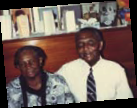
To learn more hidden truths about melanated folks early beginnings in Canada, here’s a link to the documentary Speakers for the Dead directed by Jennifer Holness & David Sutherland — 2000 | 49 min
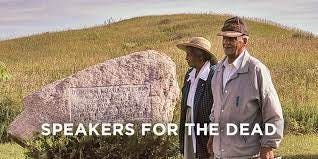
And, to find out how European people came to be known as a color —
Watch Dr. Jacqueline Battalora:
SISTAH SEASONING …
SPRINKLINGS and DASHES OF MY THOUGHTS – February 25, 2022
(journal entries)
September 2004
My trip to Halifax was no coincidence. I realize it could’ve been the Ancestors beckoning to me in spirit to go see for myself. I had wanted to go down east for a couple of years — since 2002, and it was ironic how the invitation to Cindy’s wedding last summer came during that whole thought process. I’m glad we went ‘cuz I wanted Maia to start seeing more of Canada.
The scenery was magnificent … what I didn’t like was what I learned about what happened to “Africville” the historic black settlement just outside of Halifax. Of course it conjured up feelings of resentment and anger especially after reading Mensah’s book Black Canadians. I first heard about “Africville” from Kelly’s mom, Mrs. G. years ago. Up until that point, I had never met an indigenous Black Canadian family from Nova Scotia.
Unfortunately, the bitter taste left in my mouth and subconscious resulted in a dream about Pam Dakers.
Even in the dream I could feel her superior, elitist attitude towards me, but I knew that it wasn’t entirely a race thing with her because she was like that with everybody.
The whole thing of pushing people aside is really irritating — the fact that people have a blatant disregard for others based on their differences is quite frightening actually. Shouldn’t our differences be something to be revered? Human beings could learn so much from one another if only they would stop being so damn afraid.
Over the years, I have made mental notes while observing people’s interactions with others. I think for the most part, the “attitude” is an unconscious thing. I don’t know if most white folks are even aware of the systematic racism that causes them to feel they’re better than people of color, based on their skin color. The whole color thing is crazy really. I mean, when I look at myself in the mirror and otherwise, my skin tone looks brown. It looks brown because that’s what brown looks like when I learned my colors as a kid. Even Maia will say she is brown. Kids seem conscious of color, but not the same way as adults because, fortunately they haven’t been conditioned to all of the stereotypes yet.
October 13, 2004
It has only been since 1993 when Jean Augustine, the MP for my riding of Etobicoke-Lakeshore, worked on having Black History Month passed in the House of Commons. Eleven years ago. If certain people gave credit where credit, acknowledgment, and, recognition were due, there would be no need to do this because all the history would have already been out in the open. In “The Spirit of Africville”, it’s mind-boggling to see the amount of history that has been omitted from regular history textbooks in our Ontario School System.
I wonder if it is the same down east?
April 9, 2005
The lady I sat beside for the Authenticity workshop relayed a story to me about her supervisor’s reaction when she expressed she had liked another passerby’s hairstyle (locs) during the late 70s here in Toronto. She said “oh, I like that hairdo.” Her supervisor replied, “And where do you think you’d be working with a hairdo like that”? She said she didn’t respond. How do you respond to something like that when you know whatever you say can get you fired?
April 27, 2005
There is a certain comfort in neighborhood and community. A sense of familiarity with people we share a connection with. Roger, an Asian store owner across the street, told Naz that when you phone the police, they take two hours to come after an incident once they hear your voice. He said they don’t care about Chinese people.
May 5, 2005
The missing blackness from Canada’s history is like looking through a photo album/scrapbook and there are no pictures or evidence of your own existence in a particular family. I used to feel that way whenever I would visit my mother or father and look at their so-called family albums. I was rarely acknowledged because there were hardly any physical reminders or memories of me just like how certain individuals have attempted to snuff out any memory of Canada’s early African pioneers. The old boys and girls would rather keep quiet than admit that a significant contribution was made to Canada by dark-skinned people they used to refer to as the “darkies.”
Sunday, May 25, 2005
I knew Trisha had a story, and I found out what it was today. She didn’t find out she was half-black until she was 15. Her mother and aunt had gotten into a fight and her aunt blurted out, “why don’t you tell people about your second daughter”? Trisha said she thought to herself, “what’s this about mom’s second kid (meaning her older sister)”? That was the day she discovered her father’s name was D. H., a black Guyanese man.
Trisha said when she was a kid, her mother would often leave her at home and venture out with her older brother and sister. Before finding out her real paternal ancestry, she said she knew there was something wrong with her situation. There used to be a lot of whispering and stares, but no one bothered to say anything.
September 11, 2005
I had made a mental note of this … when Khaldoun told me he only wears his “costume” at home. I realized at that point he cannot fully be himself here in Canada or North America in general, therefore, he is pretending to be someone he’s not. He can wear whatever outfit suits him (for our society) portraying the type of person he wants people to believe he is i.e. someone who is well put together. He comes across as one thing, but he is misrepresenting himself because internally, he isn’t whole.
Sunday, October 9, 2005
The little guest room I had at the cottage brought back memories of when I lived with Granny and Brother Jim.
I didn’t have my own room, however, the storage closet was made into a room that I called mine. I remember when Barb, a university schoolmate, told me one day that her mother just bought Laura Ashley for her room. I was like “oh yeah …” I knew what she was talking about, but was bewildered that she wasn’t a small kid and her mother still bought her stuff. I guess that’s what parents do for their kids. I had been working since my early teens to buy myself the things I wanted ‘cuz Granny and Brother Jim weren’t going to nor could they afford it.
Saturday, March 18, 2006
Being entrenched in years of an exclusive system causes oppression — further perpetuated by marginalization.
I find this is more prevalent in Canadian society which seems to lack unity where the assimilation of Blacks from all over the world has resulted in an unconscious continuation of demoralization. There is definitely a deeply rooted self-hate that occurs until one becomes conscious and understands one’s history. Both personal and public.
Once we’ve attained a level of unconditional self-love, love for others will become automatic. This is the autotelic (personality) i.e. loving or doing a meaningful activity for the sake of doing it with additional psychic energy.
I shamefully remember the sensation of self-loathing, particularly from seeing another dark-skinned human.
If they were blue-black, I’d feel a stirring creeping up that would say, “They’re sooo black”. Anyone wearing their hair natural, I’d see it as a reflection of me and ask myself, “why are they being so black?”, “Why are they doing that to make themselves stick out”? “Why can’t they just blend in”? Up here, racism is another beast subtlety disguised. It’s a different breed in Canada because of the fact black people have always been in the minority.
Saturday, October 14, 2006
I was explaining to Mary how the Guyana Cultural Association of Ottawa is celebrating Granny’s 105th birthday tomorrow. Mary asked, “oh … when did she die?” Me: “Die? She’s not going anywhere! God lost her file! By the way Granny’s name is Mary.” I’m beginning to think maybe God really did forget about the ‘ole gal … (hmm)?

Epistolary – March 4th, 2022
I’ve been writing letters since I was 4, to express my concerns. I’m sure there were times when the recipient opened up the letter and said to themselves, “looks like a kid wrote this”.
I write to make an inquiry not only for myself but for others who might also be affected by someone’s decision. I’ve written letters about seemingly trivial items such as the change in the Canadian Girl Guide vanilla cookie recipe (they’re now made by Dare instead of Mr. Christie) and to find out why the Malt Stop disappeared from the Bay’s (department store) basement on Rideau Street in Ottawa. They made the best chocolate malts and roasted hotdogs!
On a more serious note, in 2002 I penned a letter to former Prime Minister of Canada, Jean Chretien, pleading with him not to send our troops into Iraq. I don’t always get a response, but I have received correspondence from places like the White House and Buckingham Palace.
I am not the only artist who has been inspired to write personalized political letters to appeal to government officials or those in authoritative positions. In 1964, writer and poet June Jordan’s proposal letter to R. Buckminster Fuller (an urban planner) landed her a job with him on a project to redesign Harlem. Jordan didn’t have a formal education in architecture, however, she had been independently studying Fuller’s work. Her familiarity with Harlem, since it was her terrain, contributed to her mission to facilitate the improvement of the lives of black people by changing their physical surroundings.
C.L.R. James, a revolutionary African-American leader, is another artist who wrote political letters. From 1962 through 1963, he wrote letters to an associate, Martin Glaberman, publisher of the “Facing Reality Publishing Committee” to propose, analyze and give his perspectives for the proper development of a small Marxist organization.
At the time, Canada’s current role on the world stage prompted my letter to Michael Ignatieff, the Federal Liberal Member of Parliament for my riding of Etobicoke-Lakeshore. I hand-delivered the letter to him on December 15th, 2006 at his Christmas meet and greet.
Excerpt:
Dear Mr. Ignatieff,
My name is Roxanne Joseph. I am one of your constituents — an Etobicoke-Lakeshore resident, but more importantly an interdisciplinary artist. For the past few years, I have been examining issues relating to race and culture in a Canadian context as part of my graduate research.
I have been moved to write you this letter because I would like to (a) express my simplified analysis of Canadian affairs pertaining to racism and oppression, and (b) convey my sentiments for an expansion of Pierre Elliot Trudeau’s national vision.
My experiences are seen through the lens of a Canadian-born woman of multi-ethnic roots with brown skin. I am labeled and defined as black according to the Dominant Group (DG).
My definition of a Dominant Group means those, predominately white people, who operate the domination structures in Canada.
It has been difficult negotiating my way through a life defined as a minority with a bio-genetic classification.
I was born and raised here, but for some people in the general population, my skin color has generated assumptions about my ethnicity, personality, and history.
Our (Western) Culture is divided among colour lines and fictitious borders, structured on exclusivity and insistent on using words like minority and tolerant.
The term “visible minority” should be stopped as a beginning to shift focus away from stereotyping. Even our current Governor General Michaëlle Jean hates the idiom. It defines a majority as being invisible, and its true intention devalues people who are not in the dominant group.
The word tolerant is worse. Who is it that has to endure, suffer and put up with beliefs or practices differing from what is the norm? Does a tolerant society imply Canada’s DG initially resists people of other ethnicities who might want to take advantage of their nation? In my opinion, it does.
“Cultures of domination rely on the cultivation of fear as a way to ensure obedience. Fear is the primary force upholding structures of domination. When we are taught that safety lies always with sameness, then differences of any kind will appear as a threat. When we choose to love, we choose to move against fear — against alienation and separation. The choice to love is a choice to connect — to find ourselves in the other.”
On December 22nd, 2006 Mr. Ignatieff responded to me by e-mail which said:
Dear Roxanne,
Thank you for sending me your Christmas present, so full of thoughts about Mr. Trudeau, and the future of ethno-cultural relations in Canada.
I learned from what you wrote, especially to discard the phrase “visible minorities.”
Thank you for your present.
Best Wishes,
Michael Ignatieff
To this date, in Canada, the powers at be are still debating whether to stop calling diverse groups of people “visible minorities”.
Hopefully, they’ll figure it out.
Soon.
PREPARING ASSORTED ORGANIC EGGS – PART I – March 18th, 2022
How is identity constructed?
In an attempt to figure this out, for myself, I created a two-part project some years ago.
My intention for Part I was to locate other people born in Canada during 1967 with The Centennial Baby Project website and to acquire insight on whether or not there is actually anything special about being a Centennial Baby.
Part II, was the invention of Cheryl Kimberley Walker, a character I performed as an experiment to explore how identity is fabricated around social constructs of race, gender, and class.
Part I: The Centennial Baby Project
With the assistance of my graphic designer friend, Darek Dudzinski, The Centennial Babies of Canada website was born to celebrate this distinct period of Canadian culture. (www.centennialbabies.ca is no longer online now though)
A Centennial Baby is someone born in Canada during 1967 when Canada celebrated its 100th year anniversary of Confederation.
My objective was to reach out to other Centennial Babies across Canada and the world. I also wanted to promote an inspirational experience by allowing people to engage in a collective story as Canada approached its 140th year of Confederation in 2007.
The birth of this national project was to enable Centennial Babies to connect with others who share this status and I did manage to contact a few Centennial Babies. Some had no thoughts about the concept. Others thought it was cool. One of them happened to be K. Bell, whom I met in the seventh grade. She sounded enthusiastic about the project and I learned her mother still had the commemorative coin given to all Centennial Babies.
Having always felt unique because of this title, I sought to discover if there is an underlying meaning to being a Centennial Baby. Does this label make us feel different? What hopes do we have for our country? Do Centennial Babies have any pictures, documentation, or mementos from when they were born? How do they feel approaching forty? The website contained a questionnaire where visitors could submit their stories.
I began this Centennial Baby project keeping in mind the fluidity of identity. Former Canadian Prime Minister Pierre Trudeau’s blueprint for Canadian society was the following:
Uniformity is neither desirable nor possible in a country the size of Canada. We should not even be able to agree upon the kind of Canadian to choose a model, let alone persuade most people to emulate it. There are surely few policies potentially more disastrous for Canada than to tell all Canadians that they must be alike. There is no such thing as a model or ideal Canadian. What could be more absurd than the concept of an “all-Canadian” boy or girl? A society which emphasizes uniformity is one which creates intolerance and hate. A society which eulogizes the average citizen is one which breeds mediocrity. What the world should be seeking, and what we in Canada must continue to cherish, are not concepts of uniformity but human values: compassion, love, and understanding.
Trudeau also stated,
“If Canadians are constantly sharing their experiences, they will be constantly forming and reformulating what we may call the mainstream. Along with this new ethos come new norms of conduct and expectations for individual and even group behavior.”
Like other Centennial Babies, we would’ve been too small to even remember the political climate of our nation, Canada, which had been emerging from an era of rigid Puritan values and social attitudes. 1967 was the year when seeds of equality for women and marginalized communities were sown.
During the year-long birthday party, Expo ’67 put Canada on the international stage as tourists and dignitaries poured in from all over the world.
The residue of national pride from this time seeped into my subconscious. I always felt there was something special about having been born in Canada in 1967.
I share this title with NHL hockey player Curtis Joseph and actress Pamela Anderson who was recognized as the Centennial Baby poster child. She was the first person born on July 1st, 1967. Back then this day was called “Dominion Day” established by a statute in 1879.
On October 27, 1982, July 1st became “Canada Day.”

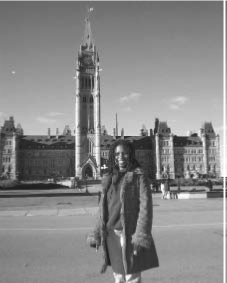

Part II: Cheryl Kimberley Walker
A performance and in-depth character analysis and identity experimentation
I performed Cheryl Kimberley Walker as a cultural figuration to examine how identity and stereotypes are constructed. Cheryl represents an exploration of who I might be had I not become conscious about my own individuality which I began to examine after the death of my grandfather.
I used to be this character who I named Cheryl, adorning a figurative mask that served two functions: (1) As a protective device to dull the daily bombardment of pain caused by constant reminders about black people being inferior in Western Culture. And (2) To avoid being viewed as a threat by looking and behaving the way society expected. Cheryl represents me as the good black girl who appeals to white people. She represents the identity created for me by myself for the Dominant Group.
I wasn’t familiar with artists who did art-life experiments until I went to Goddard and saw Danielle Abrams’ work during my first residency. In her performance piece called Quadroon, she channels four figures of kin called Janie Bell, Dew Drop Lady, Butch in the Kitchen, and Dee. I found the idea of performing a character who evoked from myself intriguing and decided to create Cheryl as an experimental illustration of how oppression, racism, and consumerism in our Western Culture continually plague my identity.
I revisited and performed who I was to reveal the seriousness and often humorous absurdity of social constructs. It was easier to step outside of myself and away from who I’d become to examine who I was and still could have been. Cheryl’s antics were captured on video — by myself, my daughter, and a few other people.
I referred to Marvin Carlson’s Performance — A Critical Introduction as a resource to study how autobiographical material is used in performance art. It provided a voice and body to generally unarticulated experiences of marginalized or oppressed communities.
I selected the names Cheryl Kimberley to symbolize common first names I often heard while growing up. A first name like mine was rare. I was afraid to tell people my name because it sounded unusual. I had enough to worry about, like being judged by my skin tone.
Cheryl’s surname derived from Madame C. J. Walker whose entrepreneurial hair straightening products took her from rags to riches. Her invention of the hair “relaxer” pomade (a hair dressing) made her one of the first wealthy African-American women in the United States.
To become Cheryl, this other person I spent years working to de/reprogram, I had to revisit the place of scarcity where I used to exist. I had to tread on dangerous terrain and remind myself of how awful it felt to operate from a place of lack. This literally manifested feelings of nausea.
I donned the mask of colonization to make myself more attractive. Now, I am the identity without a mask.
In this context, I am more personal than I used to be. For those who prefer to be real, they can assume I am being authentic by my choices and actions. I couldn’t have been the kind of mother to my daughter if I didn’t know my true identity. I finally existed in a place of authenticity, generosity, and abundance.
Studying the works of black playwrights Anna Deavere Smith, Trey Anthony, and long-time high-school friend Andrew Moodie, offered solace since all of these artists are concerned with dramatizing characters that haven’t been previously portrayed on stage. Like me, they are interested in producing work relative to modern times.
Venturing out in public to places like Starbucks, Sherway Mall, or to friends, dressed as I used to look, made me more compassionate towards black people who desperately feel they have no other way to blend in and survive but to change their God-given physical attributes. I have transcended being afraid of this part of my blackness and now embrace not only my own blackness but others as well.
The technical dynamics of performing Cheryl taught me there is much ugliness in buying into active unconscious participation. I used to be an active participant in the charade Western Culture instigates. I used to be one of the people who unknowingly executes various political agendas like imperialism and capitalism through my choice of consumption. There was no other way I could have even imagined existing in a culture that rendered anyone who was black like me — who didn’t have white or a next-to-white skin tone with the stringy hair — invisible especially when I grew up in a family of people whose perception of itself was unfavorable.
In Chapter 10 of The Colour of Democracy: Racism in Canadian Society (2nd ed. Edited by Carol Tator, Winston Mattis & Tim Rees) on page 299 the authors mention a belief in the concept of “rightness of Whiteness,” one of the primary factors in cultural racism.
I used to embody the “successful consumer” in our white supremacist capitalist patriarchal culture. My altered features i.e., hair texture portrayed an image created by the colonialists.
I had to be in denial about my blackness by pretending it didn’t exist and how I was “different” or “better” than other blacks. I considered my Canadian nationality an inherited birthright.
Ironically, Cheryl was also my collaborator for the Centennial Baby Project, but that didn’t go over very well because she expected me to do all the work.
As Cheryl, my appearance and demeanor suggested an obvious superiority attitude witnessed by everyone I’d engaged with and documented their impressions from my Cheryl performance experiment in writing. Here are some of the thoughts they had when they met Cheryl for the first time:
Malgosia: “I was unprepared to meet her … she’s someone I would never hang out with because she’s too pretentious … I don’t care about her … as long as that woman is in sight we won’t be coming over … please do not bring or send her over again …”.
Darek: “I don’t like her … she’s selfish, she thinks she’s better than anyone else. You can tell by her reaction on the streetcar. I didn’t like her comment about the air-conditioning … if it’s too fucking hot for her then she should go home.”
Maia: “She’s basically a person who cares about herself and what she looks like … she hates the wind ‘cuz it messes up her hair. She always needs her feet to have a nice pedicure. She didn’t even wait for you to come. It was rude how she just left me at someone’s house.”
People’s opinions of Cheryl were unanimous. No one liked her. Malgosia and Darek got riled up from her visit. I knew if I had still behaved like her, we probably wouldn’t be friends. Our experience of each other would be different because I would still have a self-righteous attitude and belief system.
In the essay, Developing Unity Among Women of Color: Crossing the Barriers of Internalized Racism and Cross-Racial Hostility in G. Anzaldúa’s Making Face, Making Soul, Virginia Harris and Trinity Ordoña state:
“The dominant culture has taught us well that any behavior or value not ascribed to getting ahead, achieving or acquiring is not worth having. Cooperation is for those who cannot cut it on their own, or to be used in certain circumstances when others are needed for our individual glorification, acquisition and achievement.” (p. 307)
I used to be caught up in what I call “the flow of (the) illusion.” I did not recognize how fluid my identity was. Because I didn’t want to be left out, I conformed to the status quo.
In Darryl F. Zanuck’s 1949 film Pinky, the main character played by a white actress, learns there is nothing rational about prejudice. Her name, “Pinky”, is derived because of her pale complexion. She experiences the doubt and uncertainty projected by white folks from being colored.
In a memorable scene when Pinky, Jake, and another woman were sent to Judge Walker, Pinky said to him “I’ve done nothing wrong and I’m telling you the truth, but because I’m colored you don’t believe me — you’re not sure — that’s it isn’t it”.
By the end of the film, she accepts her true identity and decides not to pretend she is someone she isn’t.
Pinky is an example of the challenges people of color born in this society with its current system of domination must endure.
As Cheryl, a colonized black woman, I was afraid to speak up and let my voice be heard. I had given up any hope of being treated as an equal. Subconsciously, the vocation I gave Cheryl was a lawyer in order for her to be a representative of justice.
According to bell hooks in killing rage — ending racism, black people who are able to attain a certain level of class power, surrender their rage. She subscribes to “white-determined standards of acceptable behavior.”
“We experience the world as infinitely less hostile to blackness than it actually is. This shift happens particularly as we buy into liberal individualism and see our individual fate as black people in no way linked to the collective fate. It is that link that sustains full awareness of the daily impact of racism on black people, particularly hostile and brutal assaults,” (p.17).
In Talking about Identity, Encounters in Race, Ethnicity, and Language (essays) edited by Carl E. James and Adrienne Shadd, Stan Isoki, a Canadian of Japanese descent says he cried for the child who attempted to assimilate and be like everyone else. Isoki writes about feeling simultaneously “visible and invisible” which caused many moments of self-doubt.
I had to acculturate in order to reap the profit of the dominant group. This describes the struggle I and other first-generation Canadians situated between two cultures must bear. I felt I had to assimilate for approval from the dominant group in Canada which marginalized the unique, lived experiences of certain communities.
In Miss Canadiana, performance artist Camille Turner examined her own Canadian identity. Camille performed her Red, White, and Beautiful Tour in a series of site-specific performances across Canada and other locations abroad.
Dressed in a tiara, ballroom gown, long white gloves, and wearing a “Miss Canadiana” sash, Camille’s performance was two-fold. She blurred the lines between reality and fiction as she successfully convinced the public she was Miss Canadiana, a fictitious title she bestowed upon herself. She documented her performances on video capturing the public’s reaction to her personae. People in various locations were seen posing with her to have their pictures taken. They believed she was a celebrity and were obviously excited to be in her presence.
Camille’s interventions engaged the public and satirized the idea of Canadian-ness, proving how much of our identity is socially constructed. Mimicking what has become a tradition of white women’s exploitation i.e., the beauty pageant winner — Camille did not use any ethnicity or race identifiers like real contests i.e., Miss Black Ontario and Miss Black Canada pageants. Turner’s only label was her nationality.
Turner says many people don’t question the legitimacy of her title believing she was the current Miss Canadiana crown holder. While performing Miss Canadiana in Dakar, Senegal, a white French woman told her that she didn’t even notice she was black, while a South American artist she met in Germany said she was playing a white girl.
On page 299 in The Color of Democracy: Racism in Canadian Society, Salome Bey, a prominent Black entertainer in Canada, makes a statement about the misrepresentation, invisibility, and marginalization of people of color by the media which communicates the message that they are not full participants in Canadian society:
“Canada today is a country where men, women, and children of color want to be seen and reflected as a vibrant and valuable component of the cultural reality of Canada, in the arts, and…everywhere. But instead, our people have run headlong into the harsh realities of institutionalized indifference, insensitivity, and ignorance that degrade us and our children. (Bey, 1983: p. 5)
My Canadian-ness meant I was born into whiteness, an ideological, political, and sociological state. For my own self-preservation, I had to shield myself from the ugliness of a white supremacist capitalist patriarchy. As a dark-skinned individual, I didn’t show my full humanity because I believed people, white or black, couldn’t handle this reality. Being fully present meant I would have to become accountable and accept responsibility for facilitating a change against oppression.
Thoughts of racism were not at the forefront of my priorities because they didn’t seem to affect me. Other things were classified as important, distracting me from the critical issues at hand. I really had nothing, but was afraid to lose what little I had. I only had my Canadian-ness and even my nationality appeared to require validation and approval from those in the dominant group.
My indoctrination was a condition of successful mass media programming crystallized over time, affecting my thoughts, beliefs, and behavior. In Himani Bannerji’s Returning the Gaze — Essays on Racism, Feminism, and Politics she describes how the state represents the interests of the most privileged class, therefore, cannot simultaneously work for the benefit of the working class because [of ] substantive differences in the interests of both classes, the two are always in conflict. “This is indeed the fundamental contradiction of capitalism.” (p. 171)
I secretly questioned why there were hardly any black Canadian lawyers or blacks in other high-profile positions. I wouldn’t have dared to inquire into this matter because I didn’t want to embarrass myself with seemingly unnecessary concerns. I also didn’t want my inquiry to be heard as whining.
In Cecil Foster’s A Place Called Heaven, Chief Justice Julius Isaac, the first black man appointed to the Supreme Court of Canada, mentions his concern about the lack of Black Canadians appointed to high-profile positions in the Canadian mainstream. He feels there is widespread bigotry against Black people in Canada.
“Room must be made for automatic appointments, otherwise, the symbolic elevation of a black person here or there will have little meaning, will be of little incentive for blacks to march into the wider society.”
In 1993, Judge Isaac made the following comment to students celebrating Black History Night at Vaughan Secondary School in Thornhill, Ontario:
“A starting point in our acceptance of our identity is the recognition that all our ancestors started life in the New World deprived of all those features of social life which promote unity and progress. They were deprived of language, culture, religion, and familial bonds, and they were required to live in the most inhumane conditions imaginable. That is our history in the United States and Canada, in the Caribbean, whether Cuba (Spanish), Santo Domingo (French and Spanish), Jamaica or Barbados (English), Brazil (Portuguese), and so on. Regardless of location, our history as victims of massive violations of human rights is the same”.
A major part of Canadian identity is its geography. Canada, the second largest country in the world, contains an abundance of uninhabitable land called “God’s Country.” And, this un-chartered space is primarily wilderness. Herein lays another conflict I used to face. I feared being associated with anything uncivilized and avoided any representation or categorization as a survival technique. I did not want to fulfill any white person’s “racist imagination.” It was called enduring the sting of racism with a smile. Primitiveness is closely linked to African-ness and racist stereotypes of the origins of black people.
Himani Bannerji’s, The Dark Side of the Nation — Essays on Multiculturalism, Nationalism, and Gender offers a twist on this notion of survival based on chronicled experiences from the European settlers first arrival in Canada.
The “Canadian,” as the dreamer of the nation, must come to terms with the wilderness in order to find and found “Canada.” S/he is white/European. The indigenous peoples are either not there or are one with the primal, non-human forces of nature. The threat to Canada, then, comes not only from south of its border but from within itself — from its denied, unincorporated, alienated nature and its human forms. (p.80)
Typically, the imagined Canada is from the European perspective; homogeneous and deeply rooted in the rivalry between two opposing sides, the French (Francophones) and English (Anglophones). Everyone else is considered ‘Other’ — fraught with social contradictions and conflicts.
One morning while combing my daughter’s hair and getting her ready for school, she noticed a suit from Cheryl’s wardrobe. She asked, “How come Cheryl’s suit is hanging there … are you going to wear it?”
I responded, “Yes … she said I could keep her clothes.”
Maia: “Mama … you know Cheryl is really you right?”
ME: “Yes, I know she is.”
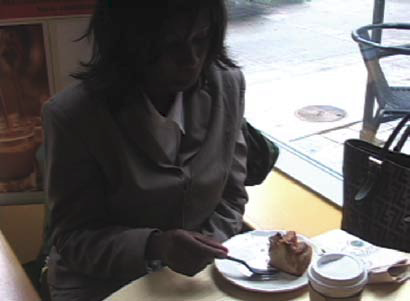
Five Steps Towards Confronting Discomfort – March 25th, 2022
With the current situation happening between Ukraine and Russia, in my opinion, it seems fair to ask “How come this crisis is permitted to take center stage in the media”?
The civil war in Ethiopia doesn’t garner the world’s attention in the same capacity?
While the Elite, politicians and corporations (a.k.a. Big Whigs) decide for all of us who is more important and what valuable resources they’re going to hoard, most civilians (a.k.a. regular folks) are distracted and have yet to figure out that a low percentage of oil for gas actually comes from Russia.
THEY can tell us anything and we’ll buy it. Literally!
Case in point, for centuries, there has been an agreement between civilians and a certain European crime family who has dared to call themselves The Monarchy. To this day this family still benefits from their Ancestor’s thievery and debauchery.
Civilians of various nations witness the spoils of The Monarchy’s exploits. They deemed themselves anointed, special, and more deserving than the Indigenous Populations whose land and human resources they stole.
Thankfully, levels of conscious awareness have risen and some people are taking a stand about their sovereignty as inhabitants on this planet. Royal walkabouts to parade around, showing off while auditing the “colonies” are no longer welcomed.
The psychotic nature of the Establishment’s belief system, upholding white supremacy, permeates Western Culture. It’s continuously being played out, however, we haven’t been taught to look at our society and think critically. If we did, states of affairs would probably be very different.
Here are five steps I’ve come up with to assist people with addressing those uncomfortable wrongs and how to go about correcting them. The same tools apply to ‘dem Big Whigs and regular folks.
- ADMITTANCE
Admit to yourself/selves about the wrong-doing, actions and behaviour. Why did it happen in the first place? BE HONEST. Consult with mental health experts if necessary. Nowadays there are plenty available so there’s no excuse!
2. ACKNOWLEDGE
Own up to how the actions and behaviour hurt and affected others. How was their life disrupted by your approach? Could things have gone differently?
3. ACCEPTANCE
Take responsibility and reflect upon your role in the series of events.
Be mindful and wake the phuq up!
4. APOLOGIZE
As some Jamaicans are declaring, “SEH YUH SORRY”!
Have integrity and compassion in the core and fiber of your being to deliver a sincere apology.
5. ATONE
Do what is necessary to repair the damage. Offer support and substantial services or reparations* as compensation.
*No amount of money can rectify the trauma of enslavement for People of African Descent…but a hundred-trillion kazillion dollars would be a good start.
Down East Home Cooking – April 1st, 2022
For most of my life, I assumed the legacy of Black people in Canada was considerably better than the historic denigration towards people of African descent in the United States. I was shocked to learn through my research about the injustices Canadian blacks suffered but was also surprised by their notable contributions to Canadian history. Excavating this evidence integral to Canadian history (which a majority of Canadians are still unaware of) has given me a feeling of validation. I found the missing ingredients essential to
contesting a ready-made identity.
“…all of Canada, from the smallest province to the biggest, was implicated in the dehumanization of Blacks through slavery; not even tiny Prince Edward Island can claim innocence in this regard. Some Black pioneers entered Canada as slaves, while others came as indentured labourers, Loyalists, refugees or voluntary settlers. Slaves were used for farming, construction, and mining, while others performed domestic duties for the Canadian elite.
After the American Revolution, when some Black Canadians were given the right to farm for themselves, they were denied title to the land; the pledges of land grants for Blacks were broken over and over across Canada.”
From: Mensah, Joseph. Black Canadians — History, Experiences, Social Conditions. Fernwood Publishers. Nova Scotia, Canada; 2004. p. 54.
Ain’t No Thing Like a Chicken Wing
Africville was a name I heard from Mrs. G. who was my hairdresser for years in Ottawa. She is also Kelly’s mom, a childhood friend. Up until Mrs. G. mentioned Africville, I had never heard anything about this former all-black Nova Scotian community in history classes at school or otherwise.
My first trip to Halifax, Nova Scotia, with my daughter Maia, occurred the summer of 2004 after my first Goddard residency. While down east, I asked my friend Cindy where I could find information about this place called Africville.
She said Sherry, her friend and work associate, would probably know and could tell me. Cindy also said, “they forgot about them Rox …”
When I asked Sherry she told me it no longer exists adding the Black Cultural Centre (BCC) in Dartmouth has an exhibit I might be interested in looking at. So, Maia and I set off for the BCC.
The issue of being shoved aside resonated with me because I was emotionally abandoned by my biological parents.
I didn’t want to accept the disturbing historical facts that fellow Black Canadians were forcibly relocated from their homes under false pretenses.
I took personal offense to this story.
My enduring adolescent curiosity fueled this formal investigation of examining Africville’s legacy and other black historical settlements across Canada. Many of which were unknown to me. For the longest time, I felt
there was a missing ingredient to Canadian culture as I knew it, and went in search of it.
Having a foundation from which to explore and engage the rest of the world is imperative to having a sense of stability. Without this place, there is always an unfulfilled longing — an infinite gap in our hearts.
In Katherine Harmon’s You are here: Personal Geographies and other maps of the Imagination, Stephan Hall’s essay “I Mercator” speaks about our need for a kind of transcendent orientation that asks not just where we are, but where and how we fit into (our) this landscape. Hall says, “The coordinates marking this territory are unique to each individual and lend themselves to a very private kind of cartography.”
For me, the home should be a comfort zone where everything aligns. It is peace of mind, body, and spirit. In this sense, I finally found a home at Goddard. I had arrived at a place where I felt accepted for the individual that I am. I was ecstatic by the treatment and reception from Goddardites (predominately Americans) from the beginning. It was as if I were meeting a long-lost family.
Researching such unsettling information took me from exuberance to resentment. It really hit home. As an indigenous Canadian, excavating this data is equivalent to looking through a family photo album or scrapbook
where there are no pictures or remnants to prove you belong in that particular family.
In my opinion, Canada, with its reputation as a safe haven for the oppressed was supposed to have been a more humane place than the United States. However, I learned through perseverance, most Canadians are still unaware of the substantial contributions and injustices of Canada’s Black pioneers. History integral to our nation’s formation.
It became my mission to bring awareness to how the story of Canada excludes black people from its collective narrative. I wanted to make this often hidden and forgotten part of Canadian heritage accessible while paying homage to those who physically and literally ‘roughed it in the bushes’ so that people like me could live in a civilized country.
I began mapping these articulations in a conceptual fashion using mixed media paintings with text and relief forms. I became a cartographer of personal and public geography painting abstract maps as a conduit to track my discovery of actual locations, past and present. I call this map series ME, YOU and the GHOSTS (see upcoming post April 15).
Multi-disciplinary artist Adrian Piper manipulates a variety of media focusing on racism and xenophobia. In Conceptual Art: A Critical Anthology, Piper discusses turning to language and conceptual symbols to explore issues in artistic works. She mentioned maps (typescript, audio tapes, etc.) and I was able to make the connection between my own work where I was constructing a “new conceptual and spatiotemporal matrice.”
I decided to experiment with this medium because I have always been interested in combining words and images. I am visually drawn to things and prefer using metaphors and symbols. For this reason, the idea of painting abstract maps seemed like the best way to show, in my mind, where these sites used to be.
In another essay in Harmon’s book, Katie Davis describes in “Memory Map” how when people (all over Latin America) give directions, they usually give details that explain what used to be there, and whatever it was, it was missed.
Examining the works of abstractionist painter storyteller Marc Chagall, helped me in this task of utilizing painting as a way to re-establish identity. Like Chagall, my intention was to re-create the story of Canada similar to how Chagall sought to reconstruct his homeland through his imagination.
The images I create are a form of resistance because I am redefining blackness in Canada. I describe my vision as being counter-hegemonic. I deconstruct preconceived notions in my environment to create anti-colonialist art within the context of our dominant culture.
In bell hooks’ Art on my Mind — Visual Politics, the chapter “Talking Art” with Carrie Mae Weems, I (am elated to) discover that like Weems, I am mapping new terrain by questioning how the story/narrative of Canada (and of people of African descent) has been told.
I join a growing list of contemporary Canadian artists who have chosen to feature the story of Africville in their artwork. Like Consecrated Ground, a fictionalized account of the catastrophe presented as a theatrical play by black Canadian playwright George Boyd, to musicians Faith Nolan and Trevor Mackenzie (who released the album Ain’t No Thing Like a Chicken Wing in 1997 as a personalized tribute to his father), my art tells the tale of identity politics in Canada.
A Critical Examination of the Historical Settlement called Africville – April 8th, 2022
The name Africville was first used by Halifax’s City Council around the turn of the century in 1867referring to the African village. In the nineteenth century both “African” and “Men of Color” were common descriptive terms.*
In November 1989 during a Halifax conference in conjunction with an exhibition titled Africville — A Spirit That Lives On, Dr. Fred MacKinnon stated his assessment of the mistakes made about the Africville relocation situation. He had been Nova Scotia’s Deputy Minister of Welfare at the time. He said: “I think the first fundamental lesson to be learned about such communities is that social and economic change cannot be manipulated, and I underline the word manipulated. We used to believe in the manipulation of people and, unfortunately, some still do. We thought that we could manipulate change in our native people for example, as so we sent them to Indian schools to make them over in the white image, and culture. They lost their own culture and didn’t take ours …”.**
As far back as the Second World War, endless complaints from Africville residents for improvements to their community fell on deaf ears. A strong sense of powerlessness, and a lack of police services, building permits, garbage pickup, and water supply assistance were never granted and plagued the community.
Not only was Africville separated from the mainstream, but it was also a Black community in a racist society. It was situated within the boundaries of Halifax but provisions of services were not provided by city officials. White inhabitants of Halifax and surrounding areas frowned upon Africville because of these factors, as did assimilated Blacks who were embarrassed by the dismal condition of Africville residents.
It was decided in 1961 by the Halifax City Council Housing Policy Review Committee, to bulldoze Africville out of existence in the late 1960s. After close scrutiny and examination, it was decided that the relocation of its citizens was justified because both the city and the Africville residents would benefit. The official reason for the relocation program was the poor quality of Africville housing.
Members of Africville and their supporters were told it would cost too much money to bring the community up to city specifications and standards. Supposedly, individual household relocation was the only alternative with the cost of acquisition and clearance of Africville property estimated between $40,000 and $70,000. This included the amount allocated for compensation with residents receiving $500 or more depending on if they owned legal title to the land where their house was situated.
Black leaders outside Africville could only express their hope for fair and generous treatment to the relocatees since they did not have the economic means or political clout to help stand up against the city.
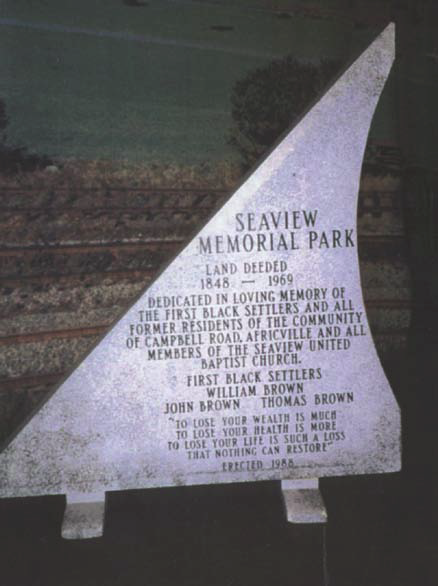
During the relocation process, Seaview Baptist Church played a significant role. It had become a symbol of the community’s strength and bond, from its establishment around 1849 until its demise. The elders of the church, Africville’s only organization, were forced to accept their powerlessness against the government. Seaview Baptist Church was flattened early one morning once its trustees accepted an offer of $15,000 for the building. The money was deposited in an education trust for black people in the Halifax area with priority given to the relocated children from Africville.
The relocation plans included creating educational programs and better opportunities for Africville residents. They were even offered subsidized housing in recently built, unsegregated, public complexes for low-income families, black and white, throughout the area. But, it wasn’t a surprise when virtually nothing materialized along those lines.
In fact, associates of the Halifax Human Rights Advisory Committee, formed in 1962 to assist the people of Africville were shocked when they discovered years later in 1968 that there hadn’t been any follow-up. One member of the City’s Africville subcommittee noted, “I assumed there was a follow-up …I didn’t know that these people were just left completely to their own resources…I should have known but I didn’t.”***
The City’s expenditure far exceeded $70,000, the original amount estimated in 1961 by its Development Department. The total cost for the Africville lands, buildings, welfare assistance, furniture allowance, the waiving of unpaid taxes and hospital bills was approximately $800,000.
With other founding members of The Africville Genealogical Society (established in 1982), in The Spirit of Africville Charles Saunders reminisces about some of the people who lived in Africville, and mentions how Duke Ellington’s father-in-law was from Africville. The Duke and his second wife, Mildred Dixon, would visit her relatives in Africville whenever he and his band came to Halifax. Joe Louis, the famous heavyweight boxer, was another frequent visitor to the community.
Saunders states: “You know, that’s one of the reasons why we don’t pay much mind when people talk down to us. If we’re good enough for folks like Joe Louis and Duke Ellington, we figure we’re darn well good enough for anybody else.”****
In 2002, the federal government designated Africville a national historic site. Where the community once stood, the city of Halifax commemorates Africville with a sundial monument.
In May 2005, a bill called the Africville Act was introduced to the provincial legislature. Maureen MacDonald, a Member of Nova Scotia’s Legislative Assembly (New Democratic Party), announced the bill calls for a formal apology from the Nova Scotia government about the community’s destruction.
The legacy of Africville remains a symbol of racism in Canada. Its history signifies a community’s struggle to maintain its identity while plagued by the ills of society. And, Africville’s fight for equality and interdependence proves how organization and solidarity are vital to overcoming inhumane issues.
Endnotes: * P. 41. The Africville Genealogical Society, The Spirit of Africville, A Maritext Book. Formac Publishing Company Ltd., Halifax, N.S. 1992. ** Ibid. P.101. *** Ibid. P. 67. **** Ibid. P.35.
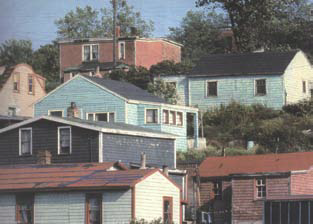
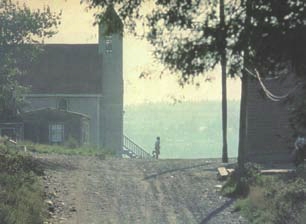

Me, You and the Ghosts – April 15th, 2022
Abstract map series of black historical settlements and sacred sites across Canada
“It isn’t easy being a ghost…people are scared of you or they don’t believe in you…” Rogers Commercial
These works represent fragments in claiming and reclaiming the voice which is fundamental to my art practice. I also speak on behalf of the silenced voices of the dead; Canada’s African pioneers via my excavation of their hidden history.
Three days before taking down my exhibit that was on display at Birds and Beans Coffee House and Roastery in South Etobicoke, Ontario (October 17th to November 17th 2005), Madeleine (the owner) said she had some interesting news for me. After seeing my piece Ode to Africville a customer turned to her and said, “Africville? My family is from there …” The man’s father is Joe Sealy, a jazz musician who won a Juno Award (Canadian version of a Grammy) for Best Contemporary Jazz Album for his record Africville Suite which coincidentally happened to be one of the cd’s playing during the opening of my exhibit.
Africville, Nova Scotia
Africville was located in the north end of Halifax. Initially, the community was settled by the black refugees of the War of 1812 before Canada’s Confederation in 1867.
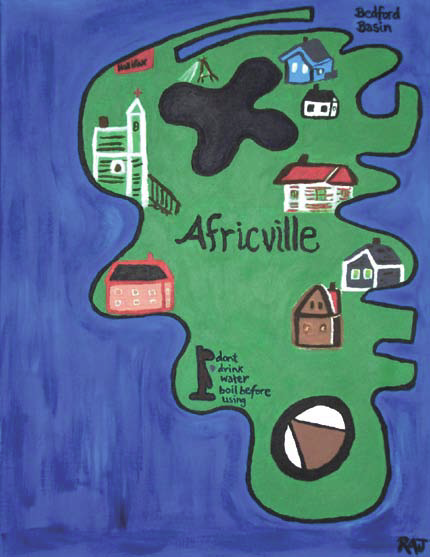
(acrylic on canvas 24×28, 2005)

(acrylic on canvas with human hair 24 x28, 2005)
St. Armand, Quebec
Located in the St. Armand area, Eastern Townships of Quebec, “Nigger Rock” was a burial ground for slaves two centuries ago.
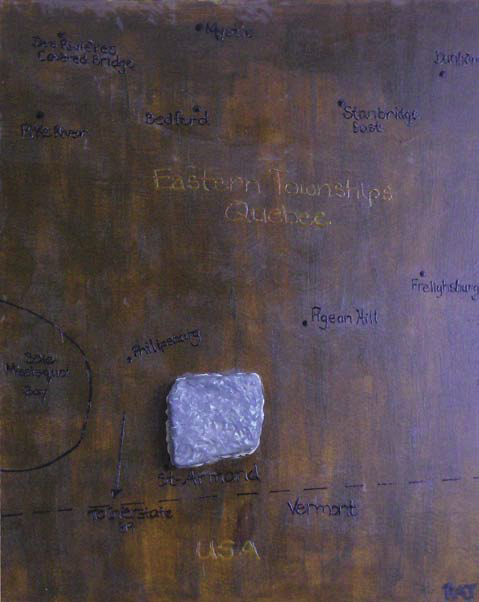
(mixed media on masonite board, 22×30, 2005)
Fort Victoria, British Columbia
Born in Demerara, British Guiana (present-day Guyana, South America) in 1803, Sir James Douglas is known as The Father of BC and for helping the Hudson’s Bay Company become a trading monopoly in the North Pacific.

(acrylic on canvas, 14×14, 2005)
“The Bog,” Prince Edward Island
In both the eighteenth and nineteenth centuries, a number of African people were brought to and enslaved in Prince Edward Island. In 1881, once their freedom was obtained, they settled in Charlottetown’s west end in an area that came to be known as “the Bog.”
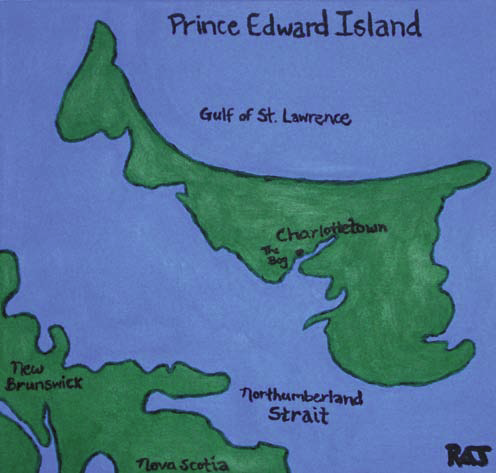
(acrylic on canvas, 14×14, 2005)
Amber Valley, Alberta
In 1910, 160 black settlers left Oklahoma for north-central Alberta. The name of their homestead, is Amber Valley a few kilometers east of Athabasca.
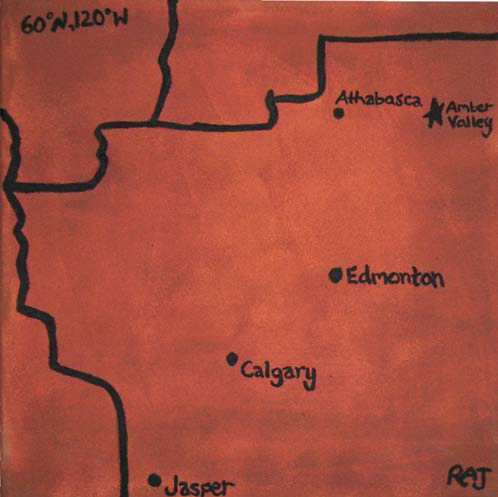
(acrylic on canvas, 14×14, 2005)
The Durham Road Cemetery, Artemesia Ontario
In the 1930s, a rural Ontario farmer Bill Reid desecrated the cemetery to make room for a potato patch.
In October 1990, the Cemetery Committee had it designated a historic site with the unveiling of a memorial, by Lieutenant-Governor Lincoln Alexander, honouring the early pioneers of African descent and Loyalists in the area.
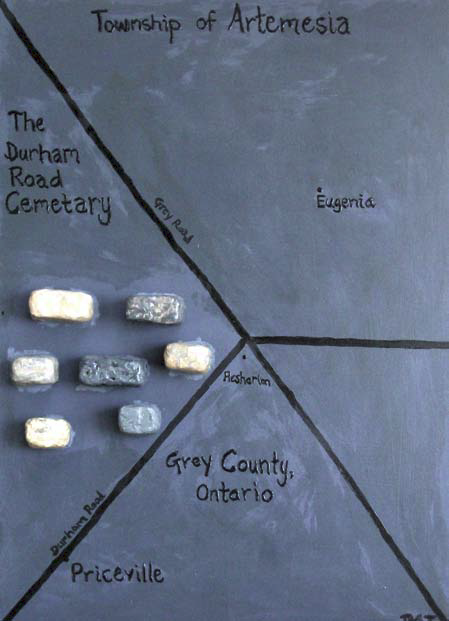
(mixed media on masonite board, 22 x 30, 2005)
Bathurst Street, Toronto Ontario
Bathurst Street was the center of Toronto’s black community in the 1940s and 1950s. The reason for this: they were denied access to housing in other areas of the city. The four corners of the intersection of Bathurst and Bloor served as a meeting place for blacks and other marginalized peoples with the arteries of Bathurst Subway, Oakwood, Vaughn Rd., St. Clair, and Eglinton down to Alexandra Park and Marlee.

(mixed media on canvas, 14 x 14, 2005)
The Faux College – April 21, 2022
It all started with the job ad I saw posted for a secondary school English teacher. I e-mailed my resume and received a response from the employer one month later.
Mr. O, the Principal, called me one morning and I went in for an interview that afternoon. The directions to the school indicated it was located inside the building of an existing elementary school. First red flag.
When I arrived, I realized the school I was applying for wasn’t the only occupant sharing the building. A daycare centre and music school also shared the premises.
Mr. O extended an offer of ten dollars per hour. This was supposed to be the wage for instructing high-school English. At a private school.
He also mentioned that I would probably teach law and history later on. Second red flag.
I asked him if I needed to come in for an orientation since I had been hired late, but he said early Monday morning would be fine.
When I got home, I immediately began to research this school…again…and discovered something peculiar on its website. Though the actual school only occupied three classrooms inside of the public school, the website inferred the entire place was theirs by showing a picture of the school’s facade.
Nowhere did it mention it was a tenant inside of another school.
The third red flag flapping…the school wasn’t listed on the Independent Schools website which is part of the Conference of Independent Schools.
I didn’t get a good feeling from my inquiries but decided I’d go with it and give the job a chance just in case they hadn’t gotten around to registering with them yet.
When I arrived Monday morning, there was a man waiting outside the office I assumed was a teacher from his demeanour. I asked him if he’d also be starting that day. He replied yes, told me his name (Zac), and explained he would be teaching math. We were to be the only teachers to a limited number of students. Whatever that meant. Everyone except for Zac and I were Somalian and of the Muslim faith.
Mr. O arrived fifteen minutes later. At this point, the students whom we had not been introduced to yet, were already in their classrooms. Their school year began 2 weeks later than the local area schools.
Zac, Mr. O, and I sat around a table in the office and Mr. O whipped up our schedules right there on the spot. Up until this point we still hadn’t received any teaching materials including a curriculum. Nor did we know how many students there were.
En route to our assigned classrooms, Mr. O told me “do something with him” waving in the direction of a small boy who’d been sitting quietly in the office with us. “Hmmm…how interesting. I didn’t realize I’d be teaching high school and elementary school simultaneously!” I said this to myself but should’ve voiced it out loud to Mr. O.
I asked the boy to write about his summer break while the 5 grade 11 and 12 students assigned to me relayed what they did in their English class last year. They said “King Lear and whatever”. And emphasized that they didn’t like Shakespeare. I started writing down ideas I could introduce to them. Ones that might actually inspire them since I was supposed to be their role model according to Mr. O during my interview. How could I not see what was ahead of me especially when the first question I was asked by one of the students was “how long are you staying?”
After Zac and I switched classrooms, I asked the three grade 10’s questions about their former curriculum. I needed to know what they’d done previously before I could proceed with new material. Material I would obviously have to wing.
Again, warning bells kept looping in my head. “What’s wrong with this picture”?
Earlier, one of the grade 12 students had told me that he wasn’t permitted to take the subjects he wanted. When he’d put in his request to Mr. O, he was told “This is what we’re offering at our school. If you don’t like it, you can leave”. On the school’s website there was an array of courses to choose from including the courses the student had selected.
I wasn’t the only one who’d picked up on the school’s disorganized administration and the way it had misrepresented itself on the website. Zac had noticed too…especially when we were handed textbooks and expected to create lesson plans for the rest of the week. Ironically, it wasn’t until after I suggested typing up a ‘code of conduct’ for the students i.e. no swearing, no disrespecting each other that I decided I’d have to quit.
The following morning, I arrived at the school intending to hand the books back to the Principal. I explained how the job situation was not going to work out for me. He asked when I was going and I told him “today”. I was not obligated to stay because I didn’t sign anything. He said I had to give him time to find a new teacher. “Didn’t you interview other candidates for this position?” I said. His response “Yes…and they’re eager to teach at my school”.
So, I headed to the class where I was scheduled to teach English to tell the students I wasn’t going to be their teacher anymore. I also wanted to say bye to Zac but would have to wait until the break between classes.
As I made my announcement, one of the students blurted out, “You’re leaving already?” I’d decided to tell them exactly how I felt. If they wanted to attend private school there were other choices. I explained how school is not supposed to be like this especially when their parents were dishing out hundreds of dollars per month. I apologized to them for having to experience this kind of thing. This wasn’t what education was about. Their parents needed to know what was going on. Some said their parents already knew but still chose to send them there due to the cultural aspect.
I wrote “disillusionment” on the board and asked if anyone knew what it meant. One of them said, “Yeah…a front like a bodega”. The three grade 12 students, all male, knew what was going on and the teacher revolving door proved it. Some lasting a week or two. Others a month. “He lies to my mother…she doesn’t believe me” another exclaimed. I figured out they must belong to the same Somali community and Mr. O had their parents convinced they would receive their high-school diplomas even if they were seemingly illiterate.
Deciding to humor myself, I asked them “by the way..where’s the state-of-the-art computer lab and recreational facility?” They all laughed and one of them chided in……you mean the gym? It’s locked and we can’t go in there because of the fire. He was referring to the fire caused by a few students letting off fireworks last year. The lone fifth grader had already filled me in.
During the break, I told Zac I wasn’t going to be staying and he didn’t seem surprised.
Halfway through our next class, I heard a ruckus in the hall, went to have a look, and saw the grade 12s. They decided they’d had enough. They were leaving and had requested their transcripts. One of them was talking to his mother and asked if I’d tell her what was going on. I took the phone and explained how this environment wasn’t conducive to learning, and told her I wouldn’t be there very much longer.
When lunch recess finally arrived Zac and I left the school to get something to eat. I was ranting about my disbelief in regard to the lack of principles while we headed for the mall across the street.
Zac lit a cigarette, took a puff, exhaled, and said, “I asked him for a ruler…he asked me what kind of ruler? Um…the one you use to measure things. He couldn’t even find one”. I laughed at this bittersweet reality. This was what the children faced going to a school where the principal didn’t even know what a ruler was. Unless of course it’s referred to by another name in Somalia or his native language?
I asked Zac, “Do you want to go to Tim Hortons”.
“No…just keep walking”! He replied.
We walked all the way to the bus stop.
It was apparent we weren’t going back to the school nor were we expecting to get paid. (We never heard from the Principal again).
Sometimes I wonder what happened to those kids.
I learned a few things from this experience:
1. Private schools in Ontario (Canada) are not regulated by the Ministry of Education. They are, however, inspected bi-annually and are considered private businesses. This school had been inspected the previous year and there was a recommendation for it to have another one the following year.
2. The website needed to look attractive to lure unsuspecting parents to send their kids there.
3. The hefty $8800/year tuition fee wasn’t going towards purchasing resources for the “school”.
4. The “Principal” was not an educator, but a slick businessman taking advantage of the people of his community and good-natured people like Zac and me, both people of colour, who wanted to make a difference.
Part II — The Faux College Woes – April 29, 2022
After eating lunch at The Dundas Street Grille, Zac and I were headed toward the subway station when I noticed a sign for an employment agency. I asked Zac if he had his resume with him figuring there wouldn’t be any harm in going to see if they could help us find another job.
When we approached the building, there was a sign indicating the office had relocated upstairs.
As we entered the office, I smelled cigarette smoke. But I ignored it.
I thought to myself, “I don’t work here so it won’t bother me. Temporarily”.
We’d come to find out that the man sitting behind a desk in the middle of the room was the assistant manager named Louis. He informed us the agency specialized in blue-collar, general labor, and steel-toe type of work. Normally, the agencies I’d temped with were for administrative-related environments. I mentioned this to Louis and he said there was something in an office. Putting small screws into bags.
He asked if I’d be interested in doing this and I said sure thinking half a loaf is better than nothing. So, I was going to E.D. for three days, Wednesday to Friday. There wasn’t anything for Joe yet and Louis asked him to call the office the following day.
Lorna, another temp from the agency, and I worked for hours the next day placing screws, bolts, and Allen keys into small plastic bags. As we worked, we chit-chatted about an assortment of topics, but we soon realized the overseers didn’t appreciate our banter.
We were given rolls of industrial-strength velcro that were to be cut into two-inch strips. There were twenty rolls per box and we were expected to complete cutting most of them. With dull scissors.
I noticed a guillotine in the corner of the space and brought it over to our area. I figured it might help speed up the process and save our hands from cramping. When I asked the nearby overseer if we could use it I was told “the blade would get dull”. Meaning, put it back where I’d found it.
The following day, the office manager suggests we use the guillotine “to move things along more quickly”. I mentioned that I’d suggested it the day before but was told the blade was a concern. He said, “Don’t worry about it. It can be replaced”.
On Friday, which would be my last day, the agency sent two additional women to work with us. Incidentally, all four of us were women of colour.
Working side by side with these women and sharing a melanated skin tone with them was a telling scene. Everything I’d read about racism and oppression in Canada, as research for my graduate work years prior, became crystal clear.
Sue was from Grenada, had been in Canada for four years, and was anxious to go back home. I wasn’t privy to Loretta’s story, but she did let on that she lived in an economically depressed part of town. I sensed both of their frustrations.
I don’t think either of these women believed there were other options for them regarding the kind of work they could do.
I’d succumbed to performing this menial task because I was a sole support parent and the jobs I was used to weren’t available. For me, this was the first time since my second year at university that I had to resort to doing general labor.
I knew I was privileged to be in this position. Having multiple pieces of paper from the system to prove it.
I could feel the overseer’s glare and knew they were judging me.
I was just another darkie in the mix. My education didn’t matter.
I was a black woman whose extra hands had been sent to help them meet their deadline.
Two days later, I get a call from Tony, the agency’s manager.
“I hear you’re educated,” he says while making me an offer to come work in the office. I accepted and agreed to start the following week.
On my first day there, I immediately got to work organizing files and began tidying up the place. The staff coordinator, Sara, didn’t seem too enthusiastic about my presence. She asked me to find someone’s phone number and while looking through the applications I noticed “B/F” written on mine. Tony had explained to me this was their system for placing people “accordingly in a suitable locale”. I’d already figured out that “B/F” meant Black Female.
Tony confesses to me later that Sara is an old friend and is perturbed because “she can’t smoke or drink her vodka and orange juice at her desk anymore”.
I couldn’t believe what I’d heard and asked him to repeat it.
Apparently, Sara used to be a bartender and came to work at the agency after the City’s new anti-smoking by-law reduced the clientele at her establishment.
Tony had already told Louis and Sara they could only smoke in his office going forward because the (second-hand) smoke bothered me and Maria, another woman of colour who worked there.
I’d been under the impression (like most people) that smoking was banned from ALL indoor workplaces.
Tony blamed his co-worker/friends for the smoking issue. He said when they moved upstairs it was supposed to be smoke-free, but whenever he left the office they’d start smoking. Louis tells me they’re going to stop smoking indoors as of Monday.
Monday rolls around. I get to work and smelled smoke.
I sauntered into Tony’s office and discovered there on his desk, a cigarette smoldering, alongside an abundance of butts in a large dirty ashtray.
I sat down on the sofa as he asked, “How are you doing today”?
“Not good. Can you please give me what I’m owed for last week so I can be on my way”.
I’d made up my mind that if the indoor smoking continued, I was out of there.
“It sounds like you’re quitting”, he said.
“It’s cause you’re smoking”, Louis chided in. Then he turned to me and stated, “Well I haven’t had any inside today”.
I tell him, “Whatever floats your boat”!
I got what I was owed and left the office.
In under five minutes.
Later that evening, I left a voice-mail message for Tony letting him know I wasn’t going to work for someone I couldn’t trust in a second-hand smoky environment. Plus it seemed they didn’t have any respect for us non-smokers or the people coming into the office.
During my “interview” conversation, Tony told me about the satisfaction he gets from knowing how grateful someone is being able “to buy a bag of rice”.
Some people who arrive at the agency are accomplished in their home country, but language and systemic barriers prevent them from working in their selected professions. According to Tony, for many others, “being sent to a below-paying, dead-end job is the best thing to happen to them compared to wherever they came from”.
Most of the job seekers at the agency are newcomers to the country.
In my opinion, their welfare wasn’t being taken into consideration coming into a cloud of second-hand smoke where a functional alcoholic was there to help them find “suitable” work.
A week or so later, Maria calls to confirm my address as she is about to mail my final cheque. Of course, I inquire if the smoking has stopped.
I didn’t tell her that I’d filed a complaint with the City’s Public Health Office.
She says, “Yes…but I don’t know how long it’s going to last”.
Do Spiritual Parasites kill people? – May 6th, 2022
When my daughter was in grade 9, on Career Day, that morning her friend Nancy had a seizure before she could get to her mother’s workplace.
Later that day, I got an e-mail that had been forwarded from Nancy’s mother, Rachel. Stella, a mutual neighbor-friend, well-acquainted with Nancy’s family had sent it.
Rachel explained the gravity of the situation in detail including how they’d arrived at the hospital, sirens blaring, within 20 minutes.
Over the years, I’d learned that Rachel grew up privileged and I’d sensed this ‘hierarchical way of being’ from her attitude towards me. An energy I’d become very familiar with growing up.
I knew that she tolerated me. As a Black woman, raising her daughter solo.
She wasn’t happy about our daughters’ friendship. And, when a sleepover turned into a two-nighter, we knew Rachel was as hot as a slithering snake’s belly in the Amazon.
Regardless of my knowing, I placed this lower-based sentiment aside and took action.
I was personally and professionally acquainted with Sophie, a world-renowned, semi-retired Pediatric Emergency Medicine Physician who worked at the same hospital Nancy had been admitted to.
I e-mailed her explaining the crisis and asked if she could call Nancy’s mother.
Without hesitation, Sophie phoned Rachel to inquire how she could be of service.
Then, Sophie let me know what had transpired during that call with the following e-mail:
Roxanne:
Last week Wednesday I phoned your friend Rachel on her cell phone. She sounded really rattled and told me it was not a good time to talk as they were awaiting some critical information. She sounded very upset. As I only come in once a week I did not try to phone from home. Please let me know what is happening and if you still advise that I call. After a week things may have resolved. Would hate to make the situation more stressful for the family,
Sophie
I must not have clearly relayed to Sophie that it was the two girls who were friends. Rachel had never expressed interest in being friends with me.
I thanked Sophie for trying to help.
And, that was the end of that.
Sophie and I silently surmised that “the rattling” was caused when she mentioned my name coupled with Sophie’s refined Jamaican accent.
It didn’t matter that Sophie is a rockstar in the field of Emergency Pediatric diagnostics.
Able to diagnose the undiagnosable.
So, when the doctors tending to Nancy didn’t know what was going on because she was my daughter’s friend, I sought assistance from the best!
I believed and still do that we should treat others the way we’d want to be treated.
Rachel never mentioned the call afterward.
Nor did I.
But, I let Stella know about Sophie and that I’d asked for her help. I also stated, “this is about Nancy”.
Two years later, at the end of the school day, Nancy had a seizure on her way home.
She’d made it to the front stairs of their house.
Where her twin brother found her. Collapsed.
When the paramedics arrived, she had already expired.
The Coroner said, “Chances are she’d died before she even hit the pavement”.
Years later, I recounted this story to Gloria, Rachel’s estranged sister about how I’d tried to help her niece.
“We’ll never know the outcome for Nancy had Sophie been able to intervene. All because of your sister’s racism”, I said.
Gloria had been aware her sister had issues, however, I could tell the news about this spiritual parasite took her grief to another level.
Lessons not taught in school – May 13, 2022
Kids understand.
Once we, as parents, give them the tools to comprehend various experiences they may encounter.
When my daughter was in elementary school, one day while combing her hair, we were chit-chatting, getting ready for school.
Maia: When is St. Patrick’s Day?
Mama: It’s Friday.
Maia: Nancy is Irish.
Mama: Yes I know. She’s half-Irish on her father’s side.
Maia: I think it’s a day for people to stay home with their families.
Mama: It’s actually a holiday in Ireland.
It was announced in the school’s mid-March newsletter that Mrs. S. (the school secretary) was leaving. March 17th was to be her last day there as she would be starting to work at a school closer to where she lives.
Mama: Friday is going be Mrs. S.’s last day.
Maia: I’m half glad she’s leaving and half sad she’s leaving.
Mama: How come?
Maia: Sometimes she’s mean to me.
Mama: Why? What did she do or say to you?
Maia: One time in the lunchroom when I didn’t have enough money for chocolate milk, she said “drink water”. I don’t her I didn’t like water. Then she said, “Too bad — I guess you’ll have nothing”.
Mama: Hmm…well, some people aren’t good at explaining things and talking to people so what they say doesn’t come out sounding too good.
Maia: She’s nice to other people.
Mama: How do you know?
Maia: She just is.
What I didn’t get into with Maia at the time was the “tone” or “attitude” she detected.
Some people, in this case, certain folks of European ancestry (who believe they’re at the top of the food chain) communicate differently to people who are of another ethnicity.
Maia was eight and she could already sense the “feeling”.
Instinctively, she knew Mrs. S. wasn’t being nice to her.
And, I couldn’t tell her she was wrong.
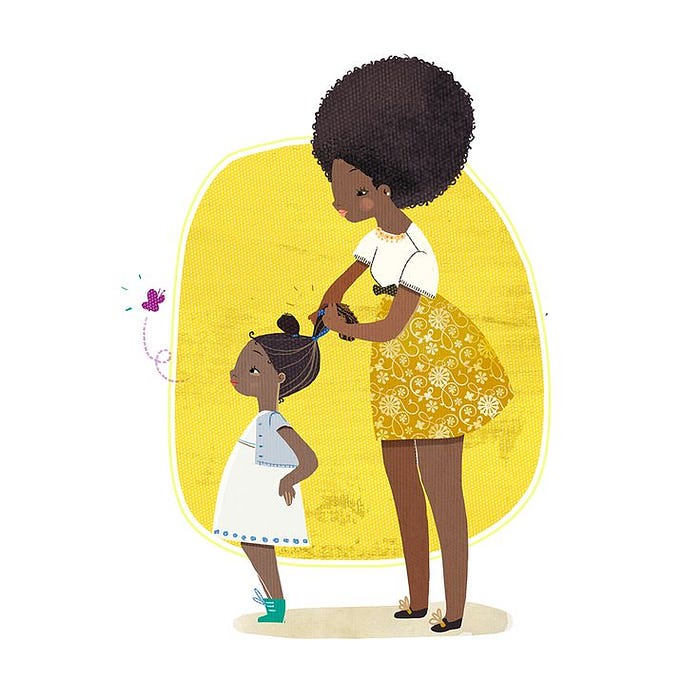
What’s your mamoo supposed to do? – May 20th, 2022
I was to lead by example.
I prayed that I wouldn’t screw up and scar you for life. Emotionally or psychologically.
No one can totally fore-warn any new parent about the invisible, lengthy scroll that gets handed to you with the baby. It contains feelings you never knew existed, in addition to custom-made, unexpected encounters unique to each child. Frequent nosebleeds, clinging to a Blankie, and sucking your thumb would be on your scroll. Thankfully, you (a) didn’t inherit your biological father’s front teeth or (b) have to wear braces. Just the image of the orthodontist’s recommendation, wearing boxing gloves on your hands at night, stopped your thumb sucking in its tracks. Whew!
In the face of many fears, I held myself together venturing into unfamiliar “good mommy” territory. This terrain had been foreign to me while growing up with Granny (and Brother Jim) but I knew it existed. I’d seen at school, Brownies, and Sunday School what good mommies did. Granny did the best she could with the resources she had to draw upon. I’d later become conscious of this and didn’t want to repeat with you any of what I considered, in my opinion, mistakes both she and my mother made with my upbringing. I would take all of the favourable guidance while relying on what felt right.
I knew from years of experience what caused discomfort.
I managed to figure out, early on, that I must be my authentic self and become a better version of myself. Whilst letting you be you. Treating you as a unique individual, The Universe entrusted me to raise, with respect and dignity,
Before you arrived on the scene, I’d ask myself “What’s my role here? What is it that I’m supposed to be doing to help make the Planet a better place? How am I going to succeed at doing it?
In Swahili, the person assigned the responsibility of asking these questions is called “Habari gani menta” which when translated into English means the person who asks “what’s happening”.
Granny used to ask me “Yuh mouth ain’t weary nuh gal”?
My mouth had been wiped with the “plate-cloth” which according to Guyanese folklore meant I talked excessively.
In hindsight, I was an inquisitive kid with an inquiring mind.
I wanted to know the details. Who, what, when. And, WHY.
Not surprisingly throughout most of high school, I wanted to become a journalist.
I literally began trying to improve the World by writing and recording my own musical compositions, when I was 13 years old. (It would take years to finally accept that my artistic strengths lay elsewhere rather than being a solo vocalist).
But, mostly, I craved Mavis’ attention. My actual mother.
Not Granny the substitute.
Your Mamoo was determined to assist in raising the Planet’s vibrational frequency. However, I became distracted by following the belief system most people are expected to in our North American society. A phenomenon you eloquently coined The Script. At twenty-eight years old, I was unmarried, childless, and found myself becoming desperate for the story to begin its unfolding. When I met your biological father, Brian, I managed to convince myself that destiny brought us together because years earlier his mother and I had worked at Bowden’s Media Monitoring.
She’d even mentioned him to me one day, but I left there before an opportunity presented itself for us to meet. Then, lo and behold, your “uncle” Michael, my brother from another mother, introduced us after he’d unsuccessfully tried to set me up with Brian’s cousin, Dexter. Michael used to manage Dexter’s hair salon.
Although he was an entrepreneur and seemed to have something going on, there was no click. And, you can’t force a connection. Either it’s there or it isn’t. In hindsight, I realize that I didn’t give the poor guy a chance as in we never even had a conversation.
Excerpt from my forthcoming non-fiction literary work, Wisdom from a Canadian Goddess: Gifting Chronicles. Glasgow Ross Publishing House.
Challenging the Beasts in Motion – May 27, 2022
After her ballet class, a teary-eyed Maia appeared and motioned me to come to see her teacher. Miss Willow informed me Maia was upset because she couldn’t do the splits. She also confided in us that not everyone in the class could do them either. Miss Willow insisted Maia shouldn’t get discouraged since there are exercises that can be done at home. She showed us the exercises and then we left. Still upset, while changing out of her ballet outfit, Maia told me:
Maia: I’m the only dark-brown girl in my class.
Mama: Is that why you feel upset?
Maia: Yes, because I can’t do the splits.
Mama: But you’re not the only one who can’t do them Maia. You shouldn’t feel bad. You’re doing your best. You’ll get better with time and practice.
Maia: I’m the only dark-brown girl in the class. I know there’s some tan girls in the class but I’m starting to feel rejected.
Mama: You have a right to be there no matter what colour skin you are.
Maia: Well…I wish I was more like the other girls in the class. They have long hair…even Rosie.
Mama: Well Maia…God made you this way.
Maia: Why can’t I change my skin colour from brown to white like Michael Jackson?
I looked at her with my eyebrows raised. Then as simply as I could put it, explained how Michael Jackson must not have liked himself.
Maia’s consciousness about her skin colour surpassed where I was in my own evolution at eight years old. She was able to freely express herself because I created a safe environment for her to do so. She was very observant and aware of the differences in skin and hair texture. She explained these feelings of exclusion as being “rejected”.
The following morning Maia awoke wanting to continue our conversation from the night before. She said she felt left out at school and ballet because she’s the only one with dark brown skin.
I told her that she can’t avoid life’s challenges (splits, math problems, etc.). The difficult parts of anything are necessary. Not permanent. They’re temporary. In order to have fun and get to the fun parts even in the things we like, sometimes we’ll be confronted with a challenge. But we can’t give up.
And, we also have to remember that occurrences are on a case-by-case basis.
Even as an adult, I was still learning about the complex nature of human beings’ behaviour.
I’d made the mistake of assuming a relative of one of the students in Maia’s ballet class had become my acquaintance. Something had come up and I’d wanted to ask this individual a question. So, I asked another person in “the group” (parents/guardians who stayed and waited after accompanying their young person to class every week) for their number.
When I called, they greeted me with “how did you get my number”? I told them who’d given it to me and proceeded to ask the question, which they answered. Then they told me to not call them again.
The shock from that emotional wallop reminded me to never make that kind of assumption.
Needless to say, I didn’t pretend I was in the company of genuine allies going forward.
Sadly, it wasn’t the first time I’d experienced this oddity.
People appearing open and friendly.
In public.
But behind closed doors, while inside their homes, ugly creatures were taking form.
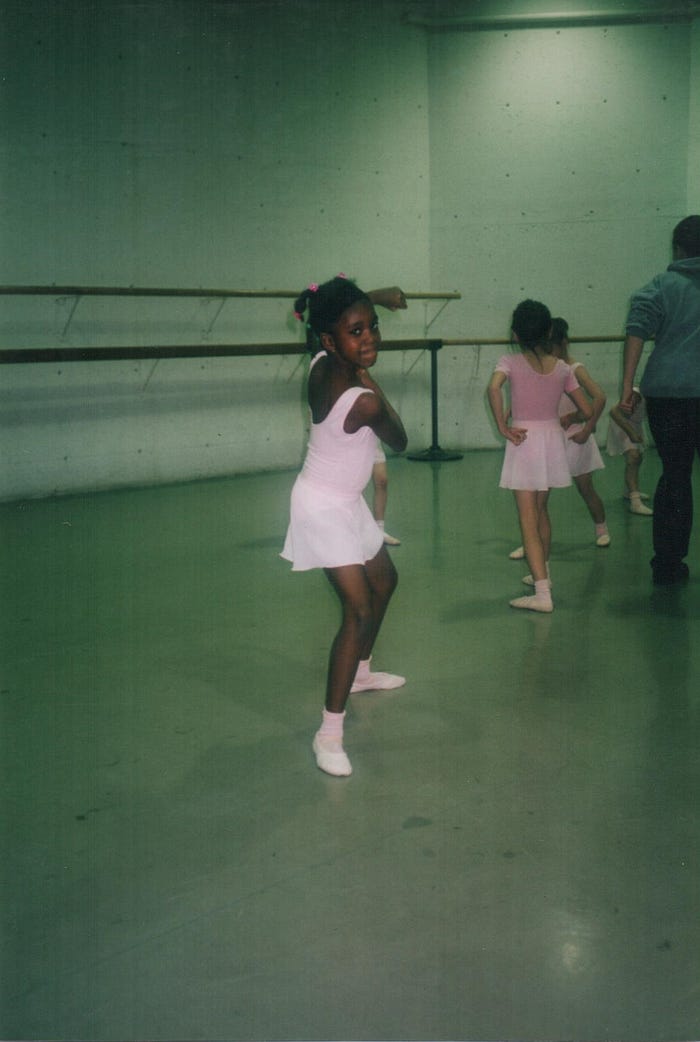
Fifth Grade Goddess-Warrior – June 3, 2022
Hello Janet,
It would be wonderful for you to find this post after all these years!
If you’re reading this story, it may jog your memory.
I’ve changed the names, as I often do, for everyone’s privacy.
I’d actually forgotten all about this incident.
But, then in the late 80’s when I re-connected with Kevin Sabinski, he asked me “Do you remember when you cut Janet Sparks’ hair”?
Kevin described in detail how I chopped off a substantial amount from your long golden locks when I was in grade 5. You were in grade 6.
We were in a split class with Miss White who’d taken over for Mr. D., our regular teacher, who’d left part-way through the year due to his nervous breakdown.
Apparently, I’d had enough of you flinging your hair in our faces. Mine and my best-friend Evie. We were the only two black students in our school.
Even as a young person, inexperienced with the ways of the world, I recognized disrespect and entitlement.
Your British accent didn’t help matters either.
I remember your tone and attitude. How you’d whip that hair of yours in our faces.
For some reason, we seemed to be standing behind you a lot in line.
You used your hair as a weapon.
Was this a conscious or unconscious maneuver?
Bubbling with resentment and frustration, I decided to put an end to your hair shenanigans once and for all.
Quietly, with scissors in hand, I carefully climbed onto the desk behind yours and proceeded to cut off a chunk from your hair. It cascaded down your back onto your sweater.
Realizing what had just taken place, you turned around, collected your hair, and jetted to Miss White with your arm outstretched.
“Roxanne cut my hair!” you screamed while shaking your hand in her face.
“Well Janet, you must’ve deserved it”!
We both stood there, looking at each other.
Surprised that I wasn’t going to be reprimanded.
When you went home, your mother had to even out the back of your hair that was lop-sided from the trim I’d facilitated.
Fast forward to our high-school days.
We eventually forgave ourselves.
We even enjoyed one another’s company chatting on the train en route from Ottawa to Toronto. You were heading on to Guelph.
I don’t think we’ve seen each other since then.
In the Matrix of our Western Culture, blonde hair epitomized the beauty standard for women.
Anyone coming close to this norm would be considered adequate.
Mainly women of European descent.
For those of us, Women of Colour from diverse ethnicities, where were we on this contrived scale?

A School Bus Saga – June 10, 2022
Some of my earliest childhood memories are becoming hazy, however, one particular moment on a school bus remains vibrant as if it occurred yesterday.
It wasn’t until I was delving into auto-biographical work during grad school that I was able to name it as a traumatic racist incident.
In those 1970’s school-buses there was a metallic, rectangular box next to the driver’s seat.
This box was the perfect size to occupy small bums and someone had figured out they could fit onto this make-shift seat.
In those days, safety wasn’t our concern.
From that point forward, taking turns sitting on the box became a cool way to pass the time while riding to and from school.
As I was sitting in the first row directly behind the driver, my five-year-old self had been assessing the situation. At long last, it was becoming clear my chance was next if I wanted it.
With the box vacated, I saw it as my opportunity to get a close-up view of the driver opening and closing the door. The maneuvering of the long stick with the black ball at the top was also intriguing.
I carefully ducked under the bar and took my position on the box next to him.
No friendly greeting or welcoming smile?
Without glancing in my direction, with his four-eyes and cap-wearing head affixed on the road, he began ramming his left elbow repeatedly into my small frame.
Breathless, I quickly got up and went back to my initial seat.
I was terrified.
I told whoever was sitting next to me that the bus driver attacked me.
A blank stare was their response.
Perhaps they were shocked at what they’d heard?
“The bus driver hit me with his elbow”!
I was the only black child who used to take the school bus.
During that era in Ottawa and well into my undergraduate days, I was often the only brown face in the mix.
The lone raisin in the milk.
The sole chocolate chip in the cookie.
The only dot on the dice.
Being mistreated by a stranger, in this capacity, wasn’t something I’d expected.
Or had I witnessed anything of the sort during my short life.
My grandparents hadn’t prepared me for such events.
It probably wasn’t something they would’ve ever predicted.
No warnings or discussions ever took place at home about what I may encounter in my everyday life as a melanated person.
After all, Canada was a civilized country.
As a parent, I established a relationship with my daughter where she felt safe to tell me anything. Our home was an open environment. Nothing was ever deemed insignificant.
I had to ensure that she was equipped with numerous tools to combat the various types of bullies and diabolical monsters waiting to pounce on unsuspecting individuals.
Even as a youngster, I felt in my being that something inexplicably wrong had been done to me.
But, I was too small to make any connection between what had just taken place and the colour of my skin.
I decided I dare not repeat it to any of my adults because I feared they’d get mad at me.
Somehow, I’d get blamed for bringing this harm upon myself for following “company”.
I didn’t talk about it because I didn’t understand what had happened to me.
Nor did I think it was significant.
And so, this story got repressed for years.
With life experience, I was finally able to put it into the correct framework.
An adult white male assaulted ME.
A black child.

The Colour of Fairness?
And injuries caused by those prejudiced-packed punches
July 30, 2022

If someone asked me to describe an experience where I believed I’d been treated unfairly, I’d try to make it a teachable, emotional-quotient (EQ) moment by conveying the mood and transmitting the feelings connected to the occurrence.
So, let us begin with my description.
What Does Unfairness Feel Like?
You’re going about your day, minding your business when someone randomly punches you smack dab in the middle of your stomach.
Out of nowhere.
You’re defenseless to the unexpected assault.
Doubled-over in pain.
Now, hold the intensity of that episode in your mind.
Add onto that sensation there’s no acknowledgment from the perpetrator about your welfare.
And no apology was offered to you from the perpetrator for their nonsensical abuse.
You might even be shocked by their callous behavior!
But remember, act as if nothing happened.
Just continue on with whatever you were doing.
Before their random knock came and disrupted your life.
When things appear out of order to me an alarm bell goes off.
PING!
Eew weee!
Something’s starting to smell stinky!
One such incident happened years ago en route back from a grad school residency on the VIA train traveling to Toronto from Montreal.
The conductor, who had more pepper than salt-colored hair, asked for my ticket.
I gave it to him and he requested to see my ISIC (International Student Identity Card).
I showed it.
He motioned to the teen-age girl beside me, who was the color of coffee with double cream, for her ticket. Then he asked to see her ISIC. She took it out and handed it to him.
Across the aisle and one row behind us, a white girl (wg) in her early twenties was seated beside an early twenties white dude (wd). The conductor took both of their tickets and had already walked a couple of feet down the aisle when the wg called out to him…“don’t you want to see my ISIC?”
He yelled back, “No, it’s okay. You look honest”.
The wg and the wd laughed!
PING!
Here we go!!
The conductor’s remark triggered that innate warning signal.
Again.
I could detect his “my tinky don’t stinky” superiority attitude!
My seatmate and I were the only two people of color in that train car.
And, he’d thoroughly inspected both of our ISICs.
What would’ve happened if we didn’t have our cards or we refused to show them to him?
“As if”!
You better believe a kerfuffle would’ve taken place.
We, People of Colour (POC) particularly black folks, don’t have the privilege to pull stunts like that.
Imaginary or otherwise.

Most of us get the “memo” earlier on in life about the snubs.
As our young psyches get battered, we’re unconsciously and simultaneously being conditioned to believe that our feelings don’t matter.
There are several cases currently in the media with videos showing African-American children at theme parks ignored by people donning character costumes.
What could have been memorable, fun experiences in “safe” spaces became encounters for civil lawsuits?
This type of unfairness is nothing new.
It’s modern technology that’s allowing unsavory conduct to be captured in progress.
Survival Mode
On The Association of Black Psychologists’ website in ‘Responding to Racial Trauma 101’, it states:
Racial trauma is the stressful impact or emotional pain of one’s experience with racism and discrimination. Additionally, racial trauma may or may not be linked to a specific event but can be experienced in the racism and discrimination one may face in daily living.
I’d started getting worked up from my observation and voiced what I’d deduced to my seatmate. She hadn’t caught on to what the conductor had passive-aggressively implied.
Maybe she didn’t want to catch it?
Denial is a common defense mechanism to dull those racist blows.
It was imperative for the conductor to see our cards.
He told the wg she “looked honest”.
Hmm.
Must have been that blonde hair of hers.
Don’t fair-haired maidens possess qualities of truth, wholesomeness, and goodness?
Isn’t this the propaganda Renaissance painters projected to most of the world for centuries?
It’s part of the social programming about color hidden in plain sight.
Black-balled. Black-listed. White lies.
Innercity is code for a poor, brown, or black neighborhood.
Phraseology was created to denote white is right.
Countless people are still unaware of the invention of White People.
Stories for other days!
Debriefing
When I got home I phoned my cousin to discuss what happened.
She said, “you must’ve been in a good mood that day ’cause you kept quiet”.
I’d considered writing a letter to customer service to complain about the conductor’s comment but decided against it since I’d been away for 10 days and needed to conserve my energy to tend to my daughter.
Sometimes, POC has to choose their battles.
Besides, I knew the physical bruise left from the punch would eventually diminish.
They always do.
I Don’t Know What To Say About My First Medium Partners Program Payment of $0.19
So, here’s nine-teen cents worth of an opinion.
August 11, 2022

As of this writing, my second from the back bottom left molar (I’ve been calling Becky Lou) needs a root canal.
I highly doubt the dentist will accept my ginormous Partners’ Program earnings as a deposit towards the small fortune needed for the treatment.
Thankfully, Becky-Lou has been behaving lately, however, I can only manage any of her outbursts temporarily.
It’s my #19 tooth.
Notice, my first Stripe deposit was for 19 cents.
Serendipitous or what eh? (I’m Canadian…remember?)
In the spirit of the Partners Program, my darling significant other presented me with a forty-five cents advance.
How sweet and supportive!
Course of action
I’ve spent the past couple of weeks researching emergency medical grants for artists since I don’t have insurance anymore and pay for dental work out-of-pocket.
There’s only 1 grant that I qualify for but won’t find out if I’ve received it until a few days before leaving to visit my daughter, whom I haven’t seen in three years, who’s been studying abroad.
Not the greatest timing I’ve experienced. By far.
The throbbing toothache ranks higher than pushing her out of my nether-regions a quarter century ago.
But, I digress.
That said, I’d like to wrap up this business with Becky Lou as quickly as possible!
She’s been a real pain in my gum!
(no pun intended)
Last year around the same time, I’d cracked a tooth and as a result had several unexpected trips to the dentist.
It’s too bad that earlier on in adulthood I didn’t pay attention to the Brownie/Girl-Guides/Scout motto, “Be Prepared”.
I wasn’t a good Brownie. I walked-up instead of flying up to Girl-Guides.
And, I hated Girl-Guides primarily because I was the only person there with brown skin. So, I took my weekly dose of getting bullied with a grin.
I wish I was better prepared for yet another dental crisis.
The lukewarm water saline rinses, ice packs, and clove oil have been working wonders though!
Are you reading this MacKenzie?
I’d be very grateful for a donation from your pot-of-gold right about now.
Obviously for some of us, receiving a no-strings-attached, unconditional monetary gift from a kazillionaire isn’t how life works.
I’m sure the former Mrs. Bezo$, other philanthropists, and public figures get inundated with requests from civilians (a.k.a. regular folk who aren’t rich or famous) to assist every challenging financial situation known to mankind.
Dung loads of unacknowledged physical and electronic mail must fill their mailboxes and inboxes.
Daily.
Realistically, for them, it’d be impossible to help everyone right?
Philanthropic Suggestions
Wouldn’t it be splendid if a Medium member with immense wealth approached the platform’s gatekeepers about starting a paid writers residency?
OR an Adopt-a-Writer program?
OR offered a scholarship?
OR a Fellows program?
How about a Writing Grant?
There are numerous Medium publications whose editors could benefit from a stipend too!
Low to no earnings over (a) certain period(s) should be a main qualifying criteria for the application process to any of the aforementioned hypothetical opportunities.
Could these types of offerings help transform our Medium community into an even more unique space? For many of us dipping in this pond, these proposals could help free up space in our brains to produce better thinking and writing.
What do you think Medium Mates…?

A top up to my earlier advance!
My advance grand total!
This windfall of sixty-five cents could’ve bought 13 pieces of Bazooka Bubble Gum back in the day.
OR
21.666 Pixy Stix.
Something IS Off With Your Attention Span!
Just in case you’ve noticed, what’s happening is NOT your imagination!
September 10th, 2022

I’d been blaming my “middle-agedness” for my shortened attention range.
For me, going “unplugged” frequently seemed to be the key to regaining a peaceful mind. So I’ve been attempting to spend more time away from the desktop computer, tablet, and cell phone. Not an easy feat when most modern professional and personal tasks are associated with online actions.
Reading and concentrating on written text on the hand-held page has even become challenging over the past few years.
I’d had a hunch that it may have been due to increased screen time and the daily constant stream of data flooding my inbox. My intuition was confirmed when I came across author Nicholas Carr’s book The Shallows: What The Internet Is Doing To Our Brains.
In case you’re in denial about it, we’re all being re-wired.
Gone are the days of waiting to discover information.
Resilience and patience levels have decreased.
The youth today are more anxious than ever before in recorded history.
ADHD and other mental health disorders are on the rise with in-person activities being replaced by online actions.
Constantly being ‘online’ and data overload has contributed to profound adverse affects on our brain’s circuitry from the “hurried and distracted thinking and superficial learning” states Carr.
According to Gary Small, a professor of psychiatry at UCLA and the Director of its Memory and Aging Center,
The current explosion of digital technology not only is changing the way we live and communicate, but is rapidly and profoundly altering our brains. The daily use of computers, smart phones, search engines, etc. stimulates brain cell alteration and neurotransmitter release, gradually strengthening new neural pathways in our brains while weakening old ones.
A former Facebook (FB) Executive and designer, Chamath Palihapitiya, doesn’t use the FB platform. Nor do his kids. He feels tremendous guilt because he helped create a tool responsible for “programming” people and “ripping apart the social fabric of how society works”.
In a 2017 interview, FB’s first President Sean Parker admitted social media sites were created to “exploit vulnerabilities in human psychology”.
During the US Senate Commerce Committee’s hearing on October 2021, FB Whistleblower Frances Haugen, who’s advocating for social media oversight, explained how the platform’s algorithms “stokes anger and division”. When it comes to the brains of teenagers, particularly four-teen year old’s, FB’s Executives have known that using the platform is addictive because the alternative, not using the platform, can lead to depression. One of the repercussions that goes along with being a social outcast.
Social Media platform creators are aware that “authentic human connectivity” is being severely interrupted and disrupted.
While my daughter was in middle school and high school, she didn’t use FB and had a rather evolved attitude about it. She said if anyone wanted to reach her, they knew where to find her and had her phone number. At the time we also had a land-line.
And, when it came to “feeling left out” because she didn’t know what was happening since events were posted on FB, she said something along the lines of “if it’s really important and meant for me to know I’ll find out”.
About twelve years ago, I deactivated my FB account five months after I opened it because I believe in my daughter’s tenants too.
A former co-worker of mine used to say, “Oh you don’t know about such and such because you’re not on FB”.
Whatever.
Choosing to communicate over FB wasn’t my priority.
I personally know a retired psychiatrist and several other business professionals who have never even owned a mobile phone. Their reasons vary from not wanting to be reached on a whim or tracked to avoiding radiation close to their body.

HOW DO WE COMBAT THIS ATTACK?
First, we have to acknowledge we are all at odds against digital technology.
We have to be in control of it rather than it taking over our lives.
Getting out of denial about our brains being re-wired is the first step toward freedom.
We come to experience our lives through disembodied symbols flickering across screens. The only way to avoid fate of losing our humanness is to have the self-awareness and the courage to refuse to delegate to computers the most human of our mental activities and intellectual pursuits, particularly “tasks that demand wisdom”. Joseph Weizenbaum, MIT Computer Scientist
Here are a few analogue activities to help stimulate your brain’s connections
- Spend time with yourself. Get to know YOU. Develop a better connection with your inner self through meditation or prayer. When the Covid-19 lockdown was in full swing in March 2020, I began a meditation-prayer regime that has helped to keep me sane to this day.
- Watch less television. I’ve found that there’s a connection between my emotions and how much tv watching is taking place i.e. when I was feeling down, I was into Y & R which I haven’t watched since 2014. Incidentally, only 4 soap operas are left in tv land.
- Turn off your phone and other devices when not in use. I’m a huge proponent of turning off my phone throughout the day. Studies have shown you’ll sleep better without having those electromagnetic frequencies disturbing your dreams.
- Re-visit using writing instruments to write a letter, note, card, or in a journal. I love creating mail and sending off packages to friends and family. People prefer receiving snail mail that isn’t a bill too!
- Read more physical pages. Sure having a Kindle or Kobo is convenient, but it’s still a screen. I don’t have either. I’m still a fan of visiting the library and bookstores.
- Go for a walk around your neighbourhood. Explore. While you’re outside walking don’t forget to look ahead and look UP!
- Get a bike. You might have to test out a few until you find “the one”. For some of us, seats can be the deciding factor but they can be changed, handle-bars altered and posts lifted.
Consider reverting back (safely) to interests you enjoyed doing during your childhood that made you happy!
Remember, it’s the quality of the flow rather than the measure of the time that’s important!
The Farewell Tour – January 22, 2023
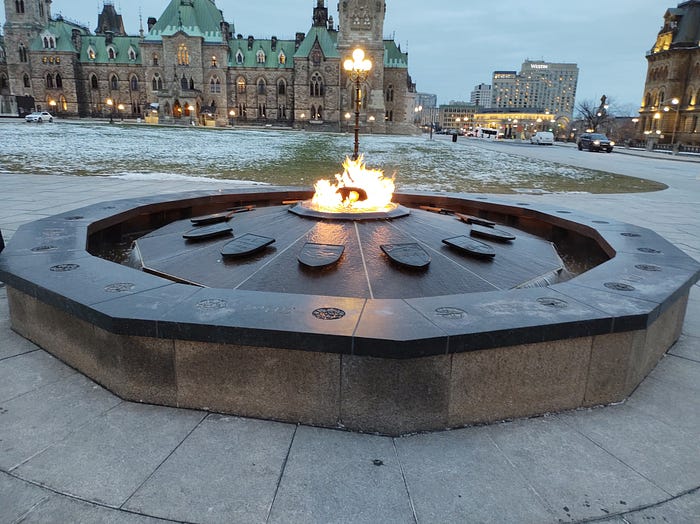
Today would’ve been my biological father’s 88th birthday.
After a brief illness that began with him falling and hitting his head, he passed away in early March last year.
I, 10 of my brothers and sisters from the same Mister, plus other close family and friends, gathered in Long Island, NY, about a week later for his Celebration of Life service.
It is said it’s mostly at events like these where people assemble who haven’t seen each other in a long time. And it’s really a shame that, too often, this is the reality.
Our Father’s request upon his passing was for his ashes to be taken back to his birthplace (Guyana, South America) and scattered into the Essequibo River.
Two of my older siblings fulfilled this undertaking last August.
Having made the decision to honour his memory in my own unique way, I chose to scatter my portion of his ashes at an appropriate spot in Ottawa, Ontario, Canada.
The first place he resided was after immigrating to North America.
Being the social creature that he was, one of several terms of endearment bestowed upon him was ‘The Mayor of Ottawa’. But his main nickname was ‘Garvey’ after the late political activist Marcus Garvey because when he was ignited, he became quite the animated orator.
I set out for what I later coined “The Farewell Tour” in mid-September.
I visited my daughter in Berlin, Germany, first, then family and friends in New York City, Toronto, Kitchener, Ottawa and Montreal before coming back to the California High Desert in mid-December. Stopping in NYC for a few days after Berlin to get my portion of the ashes before heading up to Toronto.

Coincidentally, while on the streetcar down by Toronto’s Harbourfront, my friend Denise and I saw Toronto’s Mayor John Tory on his way back from a Charity Dinner.
I thought to myself, “how funny is that since I’ll soon be heading to Ottawa to pay tribute to the Mayor of Ottawa”!
A couple of days after arriving there, I found the ideal location to pour a libation (Canada Club Whiskey), take a sip and say a few words to bid The Mayor of Ottawa, aka Garvey, Our Father, a safe, peaceful journey to the realm of The Ancestors.
I did better than I anticipated and was happy to have found an area where the water hadn’t frozen over yet. But also to be able to respect my cousin, who’s superstitious about having anyone’s ashes in her house. By the time she remembered to ask, I’d already done what I had needed to do.
Along this three-month tour, I learned that I am a truly blessed individual to have such hospitable friends and family. My sincerest gratitude and appreciation to everyone who showed me love and support. Including the bunny and two kitties.
(By the way, has anyone noticed their animals listening to the computer modem?)
I am grateful to The Universe for continuously protecting my daughter while she lives abroad and for my own safekeeping during the adventure.
There was one specific occasion in Berlin where I thought I was lost. It was my first time taking the transit, and I didn’t know I had to take a connecting line to reach another one.
That moment gave me a newly minted reverence for my daughter’s tenacity.
For over three years, she managed to flourish and thrive in a foreign country where German is her native tongue. Not an easy feat by any stretch of the imagination.
Kudos to you, BBD!
Long Live…Who?
Lilibet OR HRH Queen Elizabeth Two – January 24, 2023
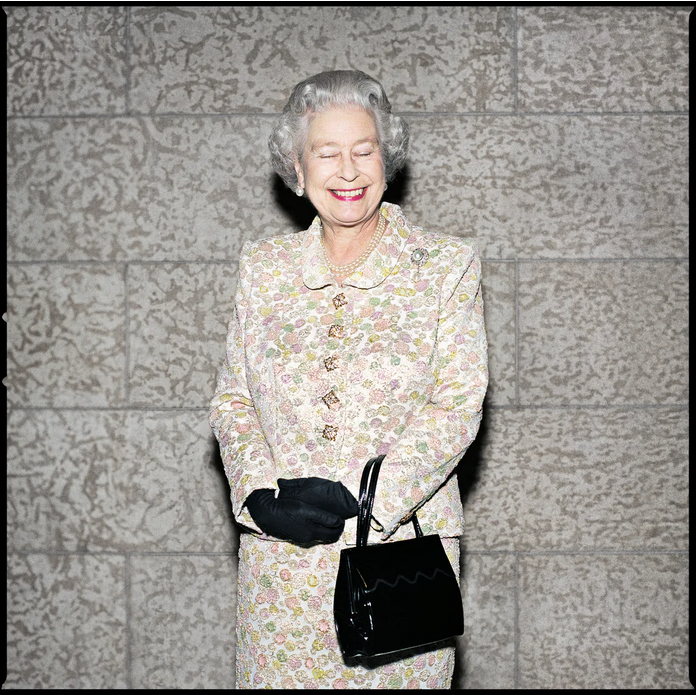
When a loved one passes on, it’s difficult to imagine being in a world without them.
Knowing that their presence is a phone call away provides us with our daily security dose.
In my opinion, the loss of a family’s matriarch, regardless of their role in society as their glue, can unhinge anyone.
To paraphrase a quote stated by the late Queen Elizabeth II,
“Grief is the price we pay for love.”
Lilibet belonged to an imperial family that continues to benefit from the spoils of their exploits.
She learned at the beginning of her reign that “The Crown must always win.” (As seen in Season 1, Episode 2 of the TV series The Crown. To me, it’s more of a documentary than a historical dramatization inspired by real events)
Crown superseded her role as a mother, wife, grandmother, sister, and daughter.
Essentially, her humanity was diminished by her position as Head of The Firm.
Admittedly, I felt a tiny twinge of sadness when the Old Gal left.
Who couldn’t relate to a Granny who “keeps marmalade sandwiches in her bag for later?”
There was a time when I believed in The British Monarchy.
I wrote a letter to Prince Edward, the Queen’s youngest son, believing that we could be pen pals. And received a response from his office.

I don’t remember why I never saw myself as one of their “subjects.” This might be related to how the Canadian media and British Tabloids portrayed them as caring folks. As a Canadian, I was an extended family member.
Somehow, the British Monarchy’s ancestors convinced groups of people to submit to this ongoing mass psychosis. The belief is that THEY are more special than others.
Their propaganda peddlers shaped the narrative to shroud the truth about how they refined white supremacy while developing their fortune.
Palaces, jewelry, and luxury cars are derived from human trafficking. Enslaved Africans kidnapped from their homes became sources of free labor to line their coffers. Human theft was central to their criminal enterprises.
The Firm’s legacy of colonizing selected nations and all the savage brutality that goes along with it created staggering wealth.
This wasn’t because they were rewarded by the universe for being paragons!
They encouraged and commissioned piracy by privateers, that is, the plundering of rival countries’ merchant ships, and settlements, because it would make them richer.
The privateer was a pirate with official documents issued by the British government.
In 2022, the country with the lowest Human Development Index (HDI) is South Sudan, where there is an abundance of cobalt. Primarily used in manufacturing cell phones.
It isn’t a coincidence that other low HDI countries have viable resources (oil, gold, tea, diamonds, uranium, etc.) found in dirt and mud that help bolster the economic interests of The British Monarchy and The West.
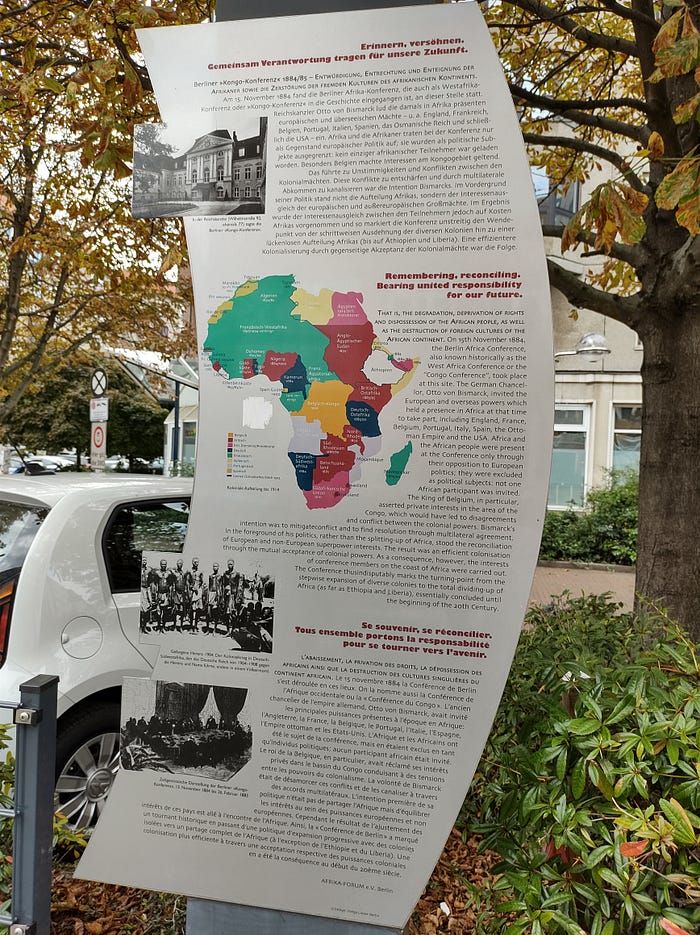
Haz is trying to activate his family’s self-awareness. However, they all remain cemented in a medieval perspective.
I think it is high time for these self-appointed Royals to get REAL!
We, The 99% Need To Ramp Things Up
So, please wake the fuq up! – January 31, 2023

To piggyback on my last post, instead of airing his family’s dirty laundry, Haz could use his platform to address more important and, relevant issues.
For instance, providing behind-the-scenes confessions from others with limitless wealth, such as the Corporatocracy’s one percent and the MotherWEFer’s, who want most of us dead.
We can surmise that Haz has cache with the one percent and has been in the company of at least one or several of them and the MotherWEFers.
His uncle Andrew and Bill Gates were associated with Epstein’s pedophile island.
Perhaps some of us would be interested in learning more about what other schemes they’re all up to since the one-percenters and MotherWEFers are inextricably linked.
I refuse to call Haz or his uncle a royal title because, in my mind, their family represents the icky residue left over from the era of inane subjugation.
What we should know thus far is that we’re the bricks and beams supporting the Establishment’s shoddy foundation.
With Transhumanism on the horizon, MotherWEFers intends to keep a few of us around to perform tasks that are not assigned to artificial intelligence.
Listen closely to the GATES of HELL.
THEY don’t care about us.
If you think THEY do, keep drinking that kool-aid.
Dust off that copy of George Orwell’s 1984. Read it again.
The surveillance state is here.
They need to know everything about US because total compliance from US is their end game.
They have failed to acknowledge that we are sovereign beings.
Faith and love are going to win over fear-based, divide-and-conquer tactics that have been running the show on the planet since history has been recorded.
Is anyone else tired of exploitation?

The MotherWEFer mob intentionally wants us to be in a constant state of divisiveness and chaos.
If we’re consumed with wondering what pronouns to use like “theyby” instead of using the gender that a baby has been assigned by nature at birth, we will not have time to minimize and end our dependence on their corporatocracy.
Vanguard, Blackrock, Monsanto, Bayer, Merck, and Pfizer to name a few.
The Corporatocracy has also manipulated our relationship with what we eat by making us dependent on mass-produced, fake food.
Many people can’t distinguish between real and genetically-modified fruits and vegetables.
Gaia’s, also known as Mother Nature, usually contains seeds.
Growing our own food in community gardens and participating in urban indoor or outdoor planting to revitalize and create alternative systems are ways to defend ourselves against political powers.
We’ve been led to believe that we are separated from the Earth, the rest of its creatures, and each other. However, it’s our connectedness to food, water, and other humans, which are vital currencies that help sustain our lives.
In fact, we need each other more than ever before.
As a collective, the majority in the West can withhold spending dollars from the corporatocracy’s supply chains by creating a new consumer cultural movement.
Between trading, bartering, supporting local, mom & pops, neighbors, artisans, flea-markets, swap meets, Farmer’s Markets, garage sales, Craigslist, Kijiji, DIYs, etc.- there are plenty of alternatives to get what we need to be comfortable, and still buy “new” and enjoy a healthier quality of life.
If we make a concerted effort to stop buying their crap, we can affect their agenda.
This means that if you can avoid putting gas into your car, do so.
Ride a bike, walk, or take public transit. If it’s absolutely unpreventable to drive, organize car pools, or ride shares.
Thus, by mobilizing within our communities and networks, we can throw more wrenches into their already thwarted plans.
The cosmos signals a lane change.
Together, we the 99 percenters can finally move away from the mess of 1%.
We’re smarter than the MotherWEFers gives us credit for.
The ultimate goal is to transcend capitalism and other long-time “isms” plaguing us as control mechanisms.
Call to Action
Spread the word!

Power Less Echo-Nomics
Beware of the Timeshare scam! – February 7, 2023

A few years ago, my boyfriend J. and I spent three nights at *The Cornercove Las Vegas Resort & Casino as part of a $99.00 package. (*Actual location name changed)
The agreement required us to take part in a sneak peek tour of said resort.
The customer support representative we spoke to over the phone insisted that we take this tour in order to qualify for the package deal.
We consented because it didn’t seem like an outrageous request.
Particularly with such a low price.
The booking representative never mentioned during the call that the tour was specifically for hotel guests to view their time-share units.
Furthermore, there was no mention of it being a trip to see time-share units in the reservation confirmation email.
We would soon discover that The Cornercove is notorious for deceiving people on purpose by failing to disclose what will actually be happening up front.
We received the time-share presentation and tour from a person by the name of Laylani (assuming that is truly her name).
We started by going inside the area that had been used for the Star Trek conventions.
“Have you ever been on a spaceship”? she asked.
Both of us, who consider ourselves to be nerds, were unimpressed.
Then, as Laylani kept giving us the spiel, we proceeded to a few different units.
Laylani asked us something along the lines of “doesn’t it seem like a good time to buy a timeshare now” in the last location.
NO, we both firmly shook our heads in agreement.
J. assured her that he did not act rashly.
“I don’t make impulse decisions”, he said.
It was clear from her silence as we made our way back to the spaceship area that she was anxious. She could feel that she was NOT going to be making a sale.
She tries to deceive us one more time before saying, “I have to send over a colleague to “close.”
Three offers came from this co-worker. The last one being significantly lower than the first.
“You’ve hit a wall”, J. said while laughing in her face.
The aroma of her stress sweat permeated my air as I laughed to myself.
And I noticed the perspiration pooling under her armpits.
Were all of them really THAT desperate to close a deal?
The sweating woman informed us that she would bring her manager, who went on to further insult our intelligence.
She emphasized that the offer was only valid for TODAY and even inquired if we had understood the information that had been given to us today.
My response to her saying that was “Can we go now”?
She finally agreed that we could leave, however, she had to send over a man to escort us to the front desk in the lobby. With a green sheet of paper in his hand indicating that we had successfully taken their “tour” he allowed us to check out.
Not the outcome they were all hoping for.
The original date for our tour was the day before, but because I didn’t have the necessary paperwork proving that J. and I had the same address, they moved it to the next morning.
We had also anticipated leaving at that time.
The booking agent had told me that the proof of address would only be required at check-in, so I had left it upstairs in the hotel room, but the front desk agent never requested it.
That’s when the alarm bells went off.
Why was this tour and proof of address so important that we had to delay our plans?
When we first arrived at the resort, we saw that a sizable portion of the patrons waiting to check-in in the casino area as well as those milling around were of a certain inclination.
Those whose outer look could lead one to believe they haven’t experienced the finest things in life.
They projected a specific stereotype.
Though I was hesitant to use the word “ghetto,” it applied here.
The Cornercove had discovered a demographic they could easily manipulate with their fancy words. People may be likely to fork out money that they didn’t have to acquire something considered “good”.
To keep up with the Joneses.
After all, in their estimation we’re considered to be emotional individuals.
Blacks and Latinos.
Absolutely disgusting on the part of The Cornercove.
After we returned home, I did some investigation and discovered that The Cornercove is only one of a select few resorts that are perpetrating this time share fraud.
But because of who they are targeting, in my opinion, they are the worst.
Intentionally preying on specific groups of people who may not be aware of how lousy a deal it truly is.
They saw us as simply another pair of losers to intimidate into paying for shared time and space.
We just happened to be there, with all of our faculties intact, to witness how they operate.
She’s Kind On Camera
Off camera, not so much! – February 7, 2023
A few years ago, I wasn’t at all shocked to learn that Ellen DeGeneres doesn’t adhere to the philosophy she once used to conclude her show:
Be Kind To One Another
I was thrilled to be able to attend the Halloween episode of The Ellen Show.
Traveling to Los Angeles for the first time, I requested tickets as a pleasant activity to do while I would be in town.
We were all required to don costumes if we were to participate in the Halloween recording as audience members.
I had decided to become a Goddess-Warrior.
Without using a pattern, the seamstress who lived next door quickly stitched my costume.
While at the YYZ airport, I’d struck up a chat with a random stranger.
In my excitement, I mentioned to her that I’d obtained tickets to Ellen’s Halloween Show. But, my remark was met by her wincing up her face as if she’d just smelled someone passing gas.
Evidently, “Ellen isn’t a nice person”, according to someone she knew who worked in security at Warner Brothers Studios.
“Are you certain he was speaking about the same cheery, be-kind-to-one-another Ellen”, I questioned her?
There is no way that this rumor could be true!
Being the insurance-minded person that I am, I filed the information that was just disclosed to me in my mental “be-on-the-lookout” file.

The day of the show’s taping eventually came two days after arriving in Los Angeles, visiting with a few old acquaintances, and viewing the Hollywood Sign in 3D.
When I arrived at the studio, it felt as though everyone had gathered there for a Halloween party and was eagerly anticipating “meeting” our special guest of honor.
And everyone looked fantastic in their chosen costumes for the taping.
Music played, people danced, and the producers of the show got us worked up with various activities as we waited to be led to another building across the street.
We were soon allowed into the studio space to take our seats after being purposefully brought to The Ellen Store, which was situated immediately outside the taping studio room.
Afterward, I understood that the show’s producers deliberately plan the timing for when unsuspecting guests visit the Ellen Store.
It’s to make sure those item purchases happen while we’re all fired up, BEFORE we find out the real story about the “lovely” host.
Ellen appeared on stage disguised as Karla, a fictional, long-lost Kardashian sister with a baby bump and her baby daddy in tow.
Kourtney Kardashian and Kendall Jenner made an appearance as themselves in person to further validate the skit.
Other notable guests included contortionist Sofie Dossi, musician J. Balvin, and Modern Family’s Julie Bowen.
Thankfully, DJ Twitch, who sadly passed away recently, did add to the relief with his music, silly outfit, and banter with Ellen.
However, it was obvious that in this instance SHE was the only one who could communicate to the crew first.
At one point, with the cameras rolling, she did say to Twitch how well we all looked.
But when those cameras weren’t filming, there was a noticeable hushed atmosphere on the set.
Ellen sat in her chair and stared at us.
She was never going to give us any extras, and that much was very clear.
When the show is edited and broadcast, she appears to be dancing alongside the audience because of the camera angles.
However, the cameramen are only capturing her dancing in close proximity to the audience.
Very different.
Over the years I’ve been to numerous show recordings on both sides of the US-Canada border.
The majority of hosts engaged with their viewers, which in my opinion demonstrated their gratitude for having our attention for several hours and bums on those seats.
Somewhat evolved folks are aware that viewers didn’t have to be there observing them throughout a taping.
I believe that in the future, Ellen could learn how to treat a studio audience better from Drew Carey and George Gray, the announcer for The Price Is Right. They are genuinely appreciative for their support.
I even got a surprising “how’s it going Roxanne” from George.
Back in the day, Phil Donahue gave a handshake to each member of the audience, looked us in the eye and thanked us for attending.
As we were leaving the recording with our prizes — Google Home and Google Mini gadgets — I questioned two Australian women about Ellen.
“She seemed to be in a bad mood”, one of them said.
A few days later, I saw a lady wearing an Ellen sweatshirt in the pre-boarding area of the LAX airport.
It turns out that she attended a taping the next day.
When I asked what she thought she said, “Well, Ricky Gervais was the guest. I don’t think she liked him because she didn’t look at him or speak to him if she didn’t have to”.
Uh huh. Yeah.
Some of my former co-workers didn’t believe me when I told them about my experience at the Ellen show when I returned to work.
Like most of us, they had bought into the scam that she, someone we all really don’t know was peddling.
I’d left the taping of the show feeling as though I’d been had.
No Access Means No Voice
And, artists need to be heard! – March 24, 2023

It happened again!
My client-friend Charlotte sent her memoir The Travels of A Cheetah: The Dancing Feline to a production company, and the package was returned to her unopened.
When I called the production company to verify the address, the recorded message indicated “We can’t accept unsolicited material”. This phraseology led me to believe that (a) they have been sued or (b) they are trying to prevent being sued.
“We don’t accept unsolicited submissions” has become the norm to avoid suits for the people whose ideas might end up being stolen. Ask Sophia Stewart. The original creator of The Matrix movie.
The former Wachowski Brothers, currently known as The Wachowski Sisters, lacked a true comprehension of the film’s message, which is apparent from their subsequent efforts. Afterward, each film was not as nuanced.
Shite like this has erected gatekeepers, so anyone whose work has not been previously vetted by an agent will not be given the time of day.
Gone are the days of randomly sending in your work, and anticipating a favorable outcome.
It’s next to impossible to access THOSE people!
And, who exactly are THOSE people?
These are behind-the-scenes movers and shakers.
Folks who are directly responsible for nurturing and promoting people who’re successful in arts and entertainment.
Elite athletes and top-tier politicians also have gatekeepers.
One could argue that sports and politics constitute entertainment.
With the rise in adverse mental health crises, high-profile people are at greater risk of receiving unwelcome attention.
If there is no need for concern, a large portion of their earnings would not have to be spent on protecting their person, which means protecting their brand.
Terry, a late acquaintance who was a personal driver and provided security to the late Lincoln Alexander, the former Lieutenant Governor of Ontario (Canada), shared many stories about famous people who sought his services.
He referred to himself as a snow plow because he could clear people out of the way if he had to.
He’d said, “They (celebrities) always have to be mindful of the crazies!”
He had to lease a bulletproof Cadillac Escalade that had to be driven up to Toronto from New York State for one client. Another client summoned her husband to ensure that he had his tip. And, he had to “find” a “lost” inebriated client who’d been “napping” under a grand piano in the hotel lobby.
Sadly, Terry, who was ironically nicknamed “Hollywood” by the late Lieutenant Governor, lost his battle with melanoma in April 2020.
Civilians, also known as regular, non-famous people, are often blocked from contacting celebrities. There is little to no chance of getting to have an enriching interaction with them or with the movers and shakers in modern times.
Hiring staff to metaphorically man the door has become necessary, which is a sad commentary on the mental health of our society.
Nobody cares what the scientists are wearing. What are you wearing Professor Allan? Pants!
The culture of a celebrity is not normal because it creates a distorted and unhealthy perception of human beings.
The non-civilians, their movers and shakers, and others who are close to them, that is, their family, friends, and relatives, if their lives are unbalanced prior to becoming notorious, there is the potential for their unresolved, pathological issues to become magnified.
In a recent interview with Stephen Bartlett, host of the podcast The Diary of a CEO, actor Cole Sprouse speaking about his relationship with acting and the entertainment industry said, “authenticity and vulnerability are not really encouraged traits.”
Cole blames entertainment media for fanning flames by sensationalizing people’s emotional pain.
He says, “They (entertainment media) don’t talk about the strengths that are the byproduct of pain. They (continuously) talk about the pain which is useless…all it does is perpetuate the past.”
Thankfully, there are people who’re in this realm that know they’re living an abnormal life like the British singer Adele.
On the CBC Radio One show Q with Tom Power, Adele told the Canadian host that she doesn’t like being famous. She said that she finds it all really strange and hard to get used to people talking about her. But, she’s aware that this dilemma comes with her profession and accepts that she has a responsibility to her audience.

Before the 2005 Academy Awards, the Comedian Chris Rock appeared as a guest on The Tonight Show. In his unfiltered style, he told Jay Leno, “the (Academy) awards don’t really affect anybody’s lives in the crowd. Meanwhile the Nobel Peace Prize, there’s no one there. You get a spot right in front of the building the day of the Nobel Peace Prize. Nobody cares what the scientists are wearing. What are you wearing Professor Allan? Pants!”
In my opinion, unbalancedness in our culture is maintained because of celebrities’ lack of engagement with the same people who admire them.
However, it is unrealistic to believe that they (non-civilians) can become real friends (not Facebook or Instagram friends) with civilians in a win-win relationship.
Their willingness to stay grounded depends on their social-emotional well-being.
Only because they’ve attained fame doesn’t mean they’ve transcended their own flaws, foibles, and insecurities. And, the legacy media ensures that strangers can know some of their personal business, with details being aired in public.
Have you ever wondered if folks in the public eye dream about civilians while they’re sleeping like we might about them?
I bet they do.
It would be a refreshing, holistic approach to life on the planet if people at the top of their game and the company they keep decide that in order for them to become fully actualized human beings, their identities must include genuine interaction with everyday people.
True authenticity cannot be attained if the elements of humility and human connections are denied.
Regardless of whether or not we’re a creative trying to have our work validated, hopefully someday there will be a cosmic shift and our civilian voices will actually be heard.
“Art is voice. Voice is Empowerment.”
Jodi Patterson (May 2, 1968 — December 15, 2021)
Gut Matters – June 10, 2023

A few months ago, I was catching up with my neighbor across the street. He was telling me about his latest gardening expeditions when I noticed the cat inside the window.
I asked, “How does LaCroix (the dog) like his new housemate?”
Then came the sad news.
LaCroix is no longer with us. He was put down earlier this year because he attacked his daughter.
“WHAT?! Why…What happened…I’m so sorry to hear this”, I exclaimed in shock.
LaCroix was the cutest, dopiest, gentle dog that wouldn’t hurt a fly.
He had one blue eye and one brown eye and rarely barked.
They discovered LaCroix’s gut microbiome had been compromised.
This, in turn, attributed to him literally losing his mind and turning on his daughter.
Knowing how important gut health is even to humans, I inquired about LaCroix’s diet.
A new, less expensive, dry dog food had been introduced to him.
It must’ve also lacked the proper nutrients that would’ve kept his gut at a healthy balance.
If this dilemma can occur with a dog, what about with us humans?
It is my experience that if I eat something that my body does not like, it will not take long to figure out what I should not have eaten. It’ll take a while longer “to address the subjects with my throne speech” the next morning.
Typically, I’ll deliver an address within an hour or two of rising.
But, if I’ve consumed foods that are at odds with my system, the throne speech gets delayed.
As someone in their mid-fifties, regular throne speeches are imperative to our overall optimum health.
And now that my “Aunt Flo has left the building” things haven’t been quite the same. When she departed she left me with certain sensitivities that I have to work harder to keep in check.
I also cannot afford to get ‘backed up’ (for a multitude of reasons) by eating any items that will risk clogging my colon.
Protecting my immune system from harmful disruptions like constipation assists with retaining my youthful appearance since my body is not stressed. Having epic throne speeches is an indication that my gut is in good working order.
I don’t feel right without my regular address.
Daily throne speeches are a result of my plumbing being kept running smoothly.
I obtain this state by drinking water, consistently stretching and exercising, and avoiding food-like products containing wheat, such as pasta or store-bought bread in a bag.
It’s not normal for us to miss having a daily address, however, there are a slew of over-the-counter products as well as herbal remedies (senna) to help get things moving along.
A Colonic also called Colon-Hydrotherapy is a modality that can help with the release of accumulated and impacted fecal matter in the colon.
Removal of waste residue in the colon is key to healing our bodies, so vital nutrients can be better absorbed. In the LA area, India’s Healthy Living Studios offers colonics, lymphatic drainage, and other alternative treatments to assist people with healthcare needs.
Conventional doctors don’t seem to want to promote ‘integrated health’ or natural ways to keep our bodies aligned.
Due to the lack of nutrients in overly processed, packaged foods, taking probiotics can help maintain the proper levels of friendly gut flora. Fermented foods such as sauerkraut and kimchi are our guts’ friends.
Healthy flora hosts trillions of bacteria called ‘Bacteroides’ and ‘firmicutes’.
The presence of more Bacteroides in the gut results in the regular elimination of toxins through bowel movements, which helps lose weight.
We are said to be ‘in synch’ when we pay attention to our ‘gut feelings.’
When the gut is in good condition, it helps in the processing and breakdown of food in the digestive system.
Our individual body composition, genetics, and lifestyle choices determine our gut function and their responsibility for keeping us healthy.
There are legitimate reasons why our gut is called our “Second Brain.”
In conclusion, gut health is crucial not just to our bodies, but to our minds and spirits.
 Pear Living
